
Sensitometry
Manufacturer reciprocity corrections use four incompatible formats
Sets Ilford’s December 2023 continuous Tc = Tm^p sheet, ADOX CHS 100 II’s October 2020 discrete multiplier lookup, Kodak T-MAX 100 F-4016’s June 2018 aperture-or-time table, and Kodak TRI-X F-4017’s December 2016 aperture-or-time-and-development table side by side as a dated correction-format matrix, recomputes only source-supported examples, and records why those published outputs cannot be collapsed into one universal reciprocity number or used to rank emulsions.
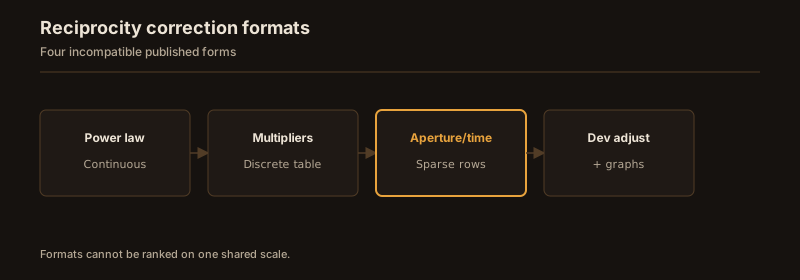
Four dated manufacturer documents publish long-exposure corrections for black-and-white film. They do not publish the same kind of number. One gives a continuous power of metered time. One gives discrete multipliers with parenthetical times. One gives sparse aperture or adjusted-time rows. One adds a development-adjustment column and points intermediate times at graphs. Those are incompatible published correction formats, not four proven distinct physical models of reciprocity failure. Treating any of those outputs as a single “reciprocity factor” that can rank emulsions invents a common scale the documents do not share.
This article is a correction-format matrix and a source-arithmetic check. It is not an exposure recipe, and it does not choose a correction for any scene. Ilford’s own sheets disagree on reciprocity floor alone; see Ilford’s reciprocity floor is half a second or one second. Speed claim-class on the Kodak T-MAX sheets is a separate citation burden before comparing exposure corrections; see ISO and EI name different claims on published film sheets.
The correction-format matrix
| Document | Date / identity | Correction format | Floor | Published end / sparsity | Development column | Stated domain beyond the table |
|---|---|---|---|---|---|---|
| Ilford Film Reciprocity Failure Compensation | Dec 2023; HARMAN technology Limited; one page | Continuous equation Tc = Tm^p with a per-film factor P |
No compensation at 1 second or shorter | Continuous for metered times above that floor; P “calculated following a range of exposure times,” with no numeric upper bound printed | None in the equation | Very long / very low-light meter accuracy may require trial and error; contrast may rise and pulling development “may be required” depending on the scene’s light-level range |
| ADOX CHS 100 II technical information | 14 Oct 2020; two pages; reciprocity block on page 1 | Discrete lookup: indicated seconds with an × multiplier and a parenthetical time | “up to 1 sec. no correction necessary” | Last row is 60 sec; no between-row interpolation rule | None | None beyond the listed rows |
| Kodak T-MAX 100, F-4016 | June 2018 (Revised 6-18) |
Sparse table: lens-aperture adjustment or adjusted exposure time | Table includes short times; long rows begin at 1 s | Long rows at 1 s, 10 s, 100 s only | No development-adjustment column in this reciprocity table | None stated for interpolating between those sparse long rows |
| Kodak TRI-X 320/400, F-4017 | December 2016 | Sparse table: aperture or adjusted time and development adjustment | Table includes short times; long rows begin at 1 s | Long rows at 1 s, 10 s, 100 s; sheet warns intermediate times between 1 and 100 s are hard to estimate from the table and points to following graphs | Yes | Graphs for times between table values; no continuous equation on the sheet |
The Ilford sheet replaces earlier single-factor graphs with per-film factors and a calculator method. It defines Tm as the metered (indicated) time, Tc as the corrected time, and P as the film factor. It does not print a numeric validity window beyond “a range of exposure times.” The long-exposure caveats above are what the sheet states; they are not an invitation to invent an upper limit or a contrast rule the page does not quantify.
ADOX’s block is not an exponent and is not fitted here to one. The page prints lines such as 2 sec: 1,5x (3 sec) through 60 sec: 6,5x (6 minutes 30 sec). It does not write an equation that names the multiplier or the parenthesis. What the arithmetic of the published rows does show is that each parenthetical duration equals indicated seconds times the printed multiplier (European decimal comma on 1,5× and 6,5×). The table stops at 60 seconds and supplies no rule for values between rows.
Kodak’s two sheets are closer to each other than either is to Ilford or ADOX: both are sparse aperture-or-time tables, and TRI-X adds a development column plus intermediate-time graphs. That is a difference in what each sheet publishes as the correction package, not a claim that the emulsions obey different physical laws. T-MAX 100’s long-exposure table is aperture or time only. TRI-X’s is aperture or time and a development percentage, with an explicit warning that estimating adjusted times between the 1 s and 100 s table points is difficult and that the graphs that follow are for those intermediate calculated times.
Worked checks that stay inside each document
These recomputations only verify that each source’s own arithmetic holds. They are not a cross-brand ranking.
Ilford’s own HP5+ example. The sheet gives P = 1.31 for HP5+ and states that a metered 10 seconds yields Tc = 10^1.31 = 20.4 seconds, rounded to a 20-second exposure. Recomputing (10^{1.31}) gives approximately 20.42 seconds, which rounds to the sheet’s 20.4 before that rounding step. The same page lists other per-film factors (among them Pan F+ 1.33, FP4+ 1.26, Delta 400 1.41); the full factor table is on the manufacturer sheet and is not reproduced here, because the finding is the correction format, not a second copy of the lookup.
ADOX multiplier × indicated time. On the CHS 100 II sheet, (2 \times 1.5 = 3), (4 \times 2 = 8), (8 \times 2.5 = 20), (15 \times 3 = 45), (30 \times 4 = 120), and (60 \times 6.5 = 390) seconds (6 minutes 30 seconds). Those identities confirm the parentheticals against the multipliers for the published rows. They do not authorise reading a value at 10 seconds, fitting a continuous p, or extending past 60 seconds.
Kodak’s own 10-second rows, named films only. For T-MAX 100 under F-4016 (June 2018), an indicated 10 seconds is “+1/2 stop” or an adjusted exposure time of 15 seconds, with no development column in that table. For TRI-X 320/400 under F-4017 (December 2016), an indicated 10 seconds is “+2 stops” or 50 seconds and “−20%” development. Those are documentary outputs for differently named products under differently dated publication numbers. The stop counts and adjusted times are not commensurate with Ilford’s Tc or ADOX’s multipliers, and putting 15 s beside 50 s is not a statement that one emulsion “needs more correction” in a shared metric.
The same Kodak sheets’ other long rows stay sparse. T-MAX 100: 1 s → +1/3 stop (change aperture; no numeric adjusted time in that cell); 100 s → +1 stop or 200 s. TRI-X: 1 s → +1 stop or 2 s and −10% development; 100 s → +3 stops or 1200 s and −30% development. No continuous interpolation is published for T-MAX 100’s table. TRI-X’s intermediate path is the sheet’s graphs, not a filled-in copy of the sparse cells.
Why the numbers do not collapse
A universal reciprocity number would need a shared dependent variable, a shared independent variable, and a shared domain. These four documents disagree on all three.
- Ilford’s dependent variable is a corrected time from a power of metered time. Kodak’s tables offer an aperture path that never becomes a single corrected-seconds figure unless the reader chooses the time column. TRI-X then couples that choice to a development change Ilford’s equation does not contain.
- ADOX’s published points are a closed discrete set ending at 60 s. Ilford’s method is continuous above one second but does not numerically bound the long end. Kodak’s long rows jump 1 → 10 → 100 s.
- Per-film Ilford P values are factors inside one manufacturer’s equation for that maker’s named films. They are not ranked against ADOX multipliers or Kodak stop adjustments, because the outputs are different physical instructions.
Michael Covington’s author corrections page for Astrophotography for the Amateur is useful here only as a caveat about his own formulae on pages 180–181: those formulae assumed that reciprocity curves share one shape and differ only in slope, and he states that assumption “has not actually been tested,” with reports of films that hold at two-minute exposures but fail at thirty minutes. That is an author limitation on a book method. It is not manufacturer evidence against Ilford’s sheet, ADOX’s lookup, or Kodak’s tables, and it is not used here as a verdict on those models.
What a citation has to carry is therefore the correction format, the product, and the revision: which equation or table, which named film, which dated sheet. A bare “reciprocity factor” with no format attached is not a usable quotation of any of these four documents.
References
- ILFORD Film Reciprocity Failure Compensation, HARMAN technology Limited; footer “Page 1 of 1 Dec 2023” — archived Ilford manufacturer PDF — https://web.archive.org/web/20250115162731id_/https://www.ilfordphoto.com/wp/wp-content/uploads/2024/05/Reciprocity-Failure-Compensation-v2.pdf; manufacturer PDF — https://www.ilfordphoto.com/wp/wp-content/uploads/2024/05/Reciprocity-Failure-Compensation-v2.pdf
- ADOX CHS 100 II B/W Film technical information, ADOX Fotowerke GmbH; “14. Okt. 2020” — https://www.fotoimpex.com/shop/images/products/media/43100_5_PDF-Datasheet.pdf
- KODAK PROFESSIONAL T-MAX 100 Film, Kodak Alaris, publication F-4016, June 2018 (
Revised 6-18) — https://www.kodakprofessional.com/sites/default/files/wysiwyg/pro/resources/f4016_TMax_100.pdf - KODAK PROFESSIONAL TRI-X 320 and 400 Films, Kodak Alaris, publication F-4017, December 2016 — https://imaging.kodakalaris.com/sites/default/files/files/products/f4017_trix_320400.pdf
- Michael Covington, “Corrections and Updates” for Astrophotography for the Amateur (author corrections page, not manufacturer evidence); note to pp. 180–181 on untested same-shape reciprocity-curve assumption — https://www.covingtoninnovations.com/astro/updates.html
Share