
Sensitometry
Ilford’s reciprocity floor is half a second or one second
Sets the November 2018 FP4 Plus and HP5 Plus fact-sheet floors — no compensation between ½ and 1/10 000 second; compensate when longer than ½ second — beside the December 2023 Film Reciprocity Failure Compensation sheet’s “one second or less” floor, records that those sheets share the FP4+ 1.26 and HP5+ 1.31 exponents while disagreeing on the floor and on whether the fact sheets used one factor for all films, and works the power-formula arithmetic that cannot increase exposure for metered times below one second.
Ilford publishes two dated reciprocity packages for the same named films. The November 2018 FP4 Plus and HP5 Plus fact sheets place the no-compensation band between ½ second and 1/10 000 second and require more exposure when the metered time is longer than ½ second. The December 2023 Film Reciprocity Failure Compensation sheet states that exposure times of one second or less need no compensation. The per-film exponents for FP4+ and HP5+ match across those packages. The floors do not. Collapsing “Ilford’s reciprocity correction” into one floor invents agreement these documents do not share.
What follows is a dated floor-and-factor matrix plus source arithmetic inside Ilford’s own equation — not an exposure recipe, and not a choice of correction for any scene. The cross-manufacturer correction-format matrix is treated in Manufacturer reciprocity corrections use four incompatible formats; the question here is only whether Ilford’s own sheets agree with each other on when compensation begins.
The floor-and-factor matrix
| Document | Date / identity | No-compensation band | When compensation begins | Named exponent / factor | How the correction is presented |
|---|---|---|---|---|---|
| ILFORD FP4 Plus technical information | Nov 2018; HARMAN technology Limited; 6 pages | “between ½ and 1/10 000 second” | “longer than ½ second” | Graph “based on the formulae Ta = Tm^1.26”; Ta = Adjusted Time; Tm = Metered Time | Graph on the film fact sheet; film-specific exponent already printed |
| ILFORD HP5 Plus technical information | Nov 2018; HARMAN technology Limited; 6 pages | Same ½-to-1/10 000 wording | Same “longer than ½ second” wording for HP5 Plus | Graph based on Ta = Tm^1.31 | Same graph-plus-formula presentation; different exponent from FP4 Plus |
| ILFORD Film Reciprocity Failure Compensation | Dec 2023; HARMAN technology Limited; 1 page | “Exposure times of one second or less will not require any compensation” | Above that one-second floor | Table: FP4+ 1.26; HP5+ 1.31 (among other films); equation Tc = Tm^P | Calculator method; no graph; per-film P table |
Both November 2018 film sheets also say the long-exposure need applies to the named film “along with other films.” That shared prose does not erase the film-specific exponents those same sheets print, and it does not reconcile them with the December 2023 one-second floor.
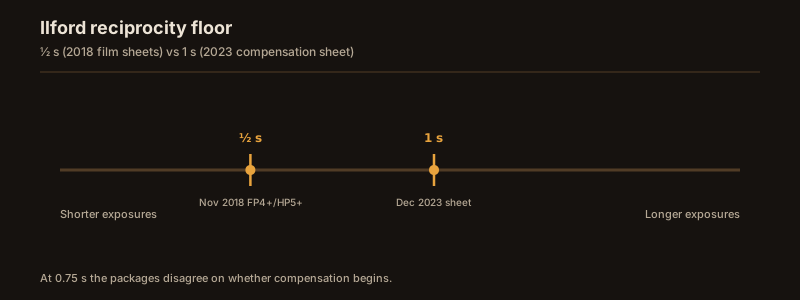
What matches, and what does not
The exponents for these two films match. December 2023 lists FP4+ at 1.26 and HP5+ at 1.31. November 2018 already prints those same numbers as the bases of the fact-sheet graphs. December 2023’s worked HP5+ example — metered 10 seconds → Tc = 10^1.31 = 20.4 seconds, rounded to 20 — is arithmetic inside that shared exponent, not evidence that the floors agree.
The floors do not match. On the fact sheets, a metered time of 0.75 second is already past “longer than ½ second” and is therefore inside the compensation region those sheets describe. On the December 2023 sheet, 0.75 second is still “one second or less” and requires no compensation. At exactly one second, December 2023 still requires none; the November 2018 prose has already been in the compensation region for half a second.
December 2023’s account of the fact sheets does not match these fact sheets. The compensation sheet says film fact sheets “use graphs based on a single factor for all our films,” and presents per-film factors as the replacement for that practice. The November 2018 FP4 Plus and HP5 Plus sheets do use graphs, but they do not share one factor: they print 1.26 and 1.31 respectively. Whatever older single-factor practice the December 2023 sentence may describe, it is not a true description of those two fact sheets.
Worked arithmetic inside Ilford’s power
Ilford’s own equation increases corrected time relative to metered time only when the metered time is greater than one second and P is greater than one. For 0 < Tm < 1 and P > 1, Tm^P is smaller than Tm.
| Metered time Tm (s) | Sheet region, Nov 2018 FP4/HP5 | Sheet region, Dec 2023 | FP4+ / P = 1.26 → Tc (s) | HP5+ / P = 1.31 → Tc (s) |
|---|---|---|---|---|
| 0.50 | Upper edge of no-compensation band | No compensation (≤ 1 s) | 0.42 | 0.40 |
| 0.75 | Compensation region (“longer than ½”) | No compensation (≤ 1 s) | 0.70 | 0.69 |
| 1.00 | Compensation region | No compensation (“one second or less”) | 1.00 | 1.00 |
| 2.00 | Compensation region | Compensation region | 2.39 | 2.48 |
| 10.00 | Compensation region | Compensation region; HP5+ example rounds 20.4 → 20 | 18.20 | 20.42 |
The 0.75-second row is the documentary conflict in one number: November 2018 prose says give more exposure than the meter; the printed power, if applied literally, shortens the time; December 2023 says give no compensation at all. This page does not invent a repair for that band. It records that these packages disagree on whether the band is inside the correction rule, and that the shared power formula cannot produce “more exposure” below one second.
Above one second the packages rejoin on factor identity for these two films. They still differ in presentation — graph on the 2018 fact sheets versus calculator-and-table on the 2023 sheet — but that is a packaging difference sitting on top of matching FP4+/HP5+ exponents, not a second floor conflict.
Why the floors do not collapse
A shared “Ilford reciprocity floor” would need a shared no-compensation band, a shared statement of when compensation begins, and a shared account of what the film fact sheets publish. These documents disagree on all three.
- Floor: ½ second (November 2018 FP4 Plus / HP5 Plus) versus one second (December 2023 compensation sheet).
- Fact-sheet factor story: December 2023 says the fact sheets used one factor for all films; the November 2018 FP4 Plus and HP5 Plus sheets already print different exponents.
- Contested half-second of meter time between ½ and 1 second: inside the fact-sheet compensation region; outside the December 2023 compensation region; and unreachable as an exposure increase by literal application of Tc = Tm^P with P > 1.
What a citation has to carry is therefore the package, the floor, and the named film’s factor: November 2018 fact-sheet floor and graph exponent, or December 2023 one-second floor and P table. A bare “use Ilford’s reciprocity factor” with no floor attached is not a usable quotation of these documents. The same November 2018 sheets carry a separate ISO-versus-EI vocabulary split; see ISO and EI name different claims on published film sheets.
References
- ILFORD FP4 Plus technical information, HARMAN technology Limited; footer “Page 1 of 6 Nov 2018” — archived Ilford manufacturer download — https://web.archive.org/web/20260214104258id_/https://www.ilfordphoto.com/amfile/file/download/file/1919/product/690/; manufacturer PDF — https://www.ilfordphoto.com/amfile/file/download/file/1919/product/690/
- ILFORD HP5 Plus technical information, HARMAN technology Limited; footer “Page 1 of 6 Nov 2018” — archived Ilford manufacturer download — https://web.archive.org/web/20260214104308id_/https://www.ilfordphoto.com/amfile/file/download/file/1903/product/695/; manufacturer PDF — https://www.ilfordphoto.com/amfile/file/download/file/1903/product/695/
- ILFORD Film Reciprocity Failure Compensation, HARMAN technology Limited; footer “Page 1 of 1 Dec 2023” — archived Ilford manufacturer PDF — https://web.archive.org/web/20250115162731id_/https://www.ilfordphoto.com/wp/wp-content/uploads/2024/05/Reciprocity-Failure-Compensation-v2.pdf; manufacturer PDF — https://www.ilfordphoto.com/wp/wp-content/uploads/2024/05/Reciprocity-Failure-Compensation-v2.pdf
Share