Sensitometry
ISO and EI name different claims on published film sheets
Sets Ilford FP4 Plus and HP5 Plus (November 2018) ISO-versus-EI splits — including Ilford’s note that recommended EI ranges are practical evaluations and not foot speed as in the ISO standard — beside Kodak T-MAX sheets that call the nominal speed an Exposure Index determined in a manner published in ISO standards, F-4043’s instruction to use those EI numbers on meters marked ISO/ASA or ISO/DIN, and ADOX CHS 100 II’s ISO-only speed line, showing that the same dial numbers are not one published kind of claim across these sheets.
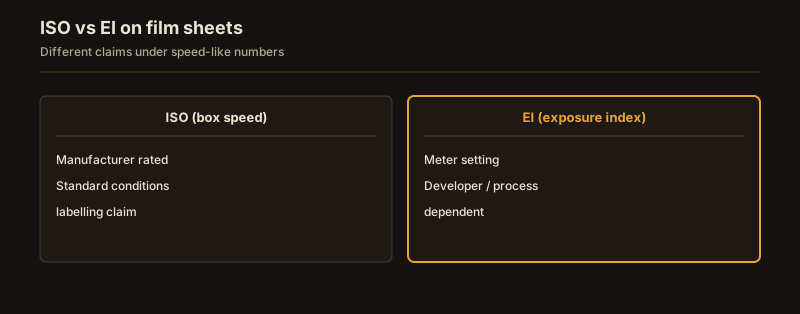
The same meter dial can be labeled ISO or EI on manufacturer film sheets. Those labels do not always name the same claim. Ilford’s November 2018 FP4 Plus and HP5 Plus sheets separate an ISO speed rating from a recommended exposure-index range and state that the EI range is a practical evaluation, not foot speed as in the ISO standard. Kodak’s T-MAX sheets call the nominal speed an Exposure Index and say it was determined in a manner published in ISO standards. ADOX CHS 100 II’s October 2020 technical information publishes “Speed: ISO 100/21°” and never uses EI vocabulary on that sheet. Collapsing those usages into one “box speed” invents a shared claim the documents do not share.
This article is a dated vocabulary matrix. It is not an exposure recipe, and it does not choose a meter setting for any film or developer.
The claim-class matrix
| Document | Date / identity | What is called ISO | What is called EI | Stated relationship |
|---|---|---|---|---|
| ILFORD FP4 Plus technical information | Nov 2018; HARMAN technology Limited; 6 pages | Speed rating ISO 125/22º to daylight, measured using ILFORD ID-11 at 20°C/68°F with intermittent agitation in a spiral tank | Best results at EI 125/22; good image quality also from EI 50/18 to EI 200/24 | “the exposure index (EI) range recommended for FP4 Plus is based on a practical evaluation of film speed and is not based on foot speed, as is the ISO standard” |
| ILFORD HP5 Plus technical information | Nov 2018; HARMAN technology Limited; 6 pages | Title and body rate the film at ISO 400/27º; body: “Although rated at ISO 400/27º…” | Best results at EI 400/27; good image quality also from EI 400/27 to EI 3200/36 | Same foot-speed disclaimer for the recommended EI range; the Exposure Rating block on that sheet does not reprint FP4’s ID-11 measurement sentence |
| KODAK PROFESSIONAL T-MAX 100 Film, F-4016 | June 2018 (Revised 6-18) |
Features line: “medium speed (ISO 100/21° in most developers)” | “The nominal speed … is EI 100. It was determined in a manner published in ISO standards.” | No Ilford-style split that EI is not foot speed; no F-4043-style paragraph that all speed numbers “are expressed as” EI |
| KODAK PROFESSIONAL T-MAX 400 Film, F-4043 | February 2016 | Features line: “high speed (ISO 400/27° in most developers)” | Nominal speed EI 400, “determined in a manner published in ISO standards”; “The speed numbers for this film are expressed as Exposure Indexes (EI)” for meters or cameras marked for ISO/ASA or ISO/DIN; developer table can change the EI (HC-110 Dilution B: 320 / 26°) | EI is the working meter vocabulary, including a developer-dependent row below the ISO 400 features line |
| ADOX CHS 100 II technical information | 14 Oct 2020; two pages | “Speed: ISO 100/21°”; development table carries an ISO column that can read 100/21° or 125/22° by developer row | None on that sheet | No EI term; no foot-speed disclaimer; contrast is labeled BETA (0.65 / 0.70), not Contrast Index |
The Ilford sheets are the only ones in this set that publish an explicit negative: recommended EI is not the ISO foot-speed method. Kodak’s T-MAX sheets go the other way for the nominal figure: they name it EI and attach ISO-standard determination language. ADOX’s sheet never uses EI vocabulary at all.
What each sheet is actually attaching to the dial
Ilford keeps two lanes. On FP4 Plus, ISO 125/22º is a measured speed rating under named processing conditions. EI 125/22 is then the “best results” meter setting, with a published good-quality band from EI 50/18 to EI 200/24 that the sheet refuses to call foot-speed ISO. HP5 Plus uses the same disclaimer template, but its published good-quality EI band runs from EI 400/27 up to EI 3200/36 — an upward practical range tied to push development language elsewhere on the sheet — and the Exposure Rating block does not restate FP4’s ID-11 measurement sentence. “Although rated at ISO 400/27º” is still an ISO rating claim; it is not the same paragraph as FP4’s measured-conditions sentence.
Kodak T-MAX folds the nominal figure into EI. F-4016’s features line says ISO 100/21° in most developers; the Exposure section’s load-bearing sentence is “The nominal speed … is EI 100,” determined in a manner published in ISO standards. F-4043 does the same for EI 400, then adds the explicit instruction that the film’s speed numbers are expressed as Exposure Indexes for use on meters marked ISO/ASA or ISO/DIN, and that the developer affects the exposure index. The HC-110 (B) row at 320 / 26° is therefore an EI instruction on a sheet whose features line still says ISO 400/27° in most developers. That is a documentary mismatch of labels on one product sheet, not a measurement of two different emulsions.
ADOX publishes ISO, and sometimes a different ISO in the table. The masthead speed is ISO 100/21°. The development timetable’s ISO column stays at 100/21° for many rows and prints 125/22° for others (including ADOX ADX and one SILVERMAX row). The sheet never calls those table values exposure indexes. It also never states Ilford’s practical-versus-foot-speed distinction.
Why the numbers do not collapse
A shared “box speed” reading would need a shared kind of claim: the same quantity, under the same method, with the same relationship between the printed ISO and any EI. These sheets disagree on all three.
- Ilford’s EI range is defined against the ISO method (“not … foot speed, as is the ISO standard”). Kodak’s nominal EI is defined with ISO-manner determination language.
- Ilford’s good-quality EI bands are not the same shape: FP4’s band straddles the ISO rating; HP5’s published band in the Exposure Rating block starts at the rating and runs upward.
- Kodak F-4043’s developer EI table can move the meter number while the features ISO line stays at 400. ADOX’s table can move an ISO-column value without ever saying EI.
- F-4016 does not carry F-4043’s “expressed as Exposure Indexes” paragraph. Same manufacturer family, different published apparatus on those revisions.
Kodak PROFESSIONAL TRI-X 320 and 400 Films, F-4017 (December 2016), is useful here only as a boundary: that sheet’s Exposure section leads with a daylight exposure table and later uses EI figures for push-processing tables, without the T-MAX “nominal speed is EI … determined in a manner published in ISO standards” block and without an ISO speed-rating sentence of the Ilford kind. It is not a third full ISO/EI apparatus in this matrix; it is evidence that even within Kodak’s film sheets the speed-vocabulary package is not uniform.
What a citation has to carry is therefore the kind of claim, the product, and the revision: ISO rating under named conditions, practical EI band, nominal EI with ISO-manner language, or ISO-only table. A bare “ISO 400” or “EI 400” with no kind of claim attached is not a usable quotation of these documents. Contrast targets on the same sheets are a separate vocabulary problem; see Contrast Index, BETA, and average contrast name different targets. Ilford’s November 2018 FP4/HP5 sheets also disagree with a later package on reciprocity floor; see Ilford’s reciprocity floor is half a second or one second.
References
- ILFORD FP4 Plus technical information, HARMAN technology Limited; footer “Page 1 of 6 Nov 2018” — archived Ilford manufacturer download — https://web.archive.org/web/20260214104258id_/https://www.ilfordphoto.com/amfile/file/download/file/1919/product/690/; manufacturer PDF — https://www.ilfordphoto.com/amfile/file/download/file/1919/product/690/
- ILFORD HP5 Plus technical information, HARMAN technology Limited; footer “Page 1 of 6 Nov 2018” — archived Ilford manufacturer download — https://web.archive.org/web/20260214104308id_/https://www.ilfordphoto.com/amfile/file/download/file/1903/product/695/; manufacturer PDF — https://www.ilfordphoto.com/amfile/file/download/file/1903/product/695/
- KODAK PROFESSIONAL T-MAX 100 Film, Kodak Alaris, publication F-4016, June 2018 (
Revised 6-18) — https://www.kodakprofessional.com/sites/default/files/wysiwyg/pro/resources/f4016_TMax_100.pdf - KODAK PROFESSIONAL T-MAX 400 Film, Kodak Alaris, publication F-4043, February 2016 — https://www.kodakprofessional.com/sites/default/files/wysiwyg/pro/resources/f4043_TMax_400.pdf
- ADOX CHS 100 II B/W Film technical information, ADOX Fotowerke GmbH; “14. Okt. 2020” — https://www.fotoimpex.com/shop/images/products/media/43100_5_PDF-Datasheet.pdf
- KODAK PROFESSIONAL TRI-X 320 and 400 Films, Kodak Alaris, publication F-4017, December 2016 — https://imaging.kodakalaris.com/sites/default/files/files/products/f4017_trix_320400.pdf
Share