Sensitometry
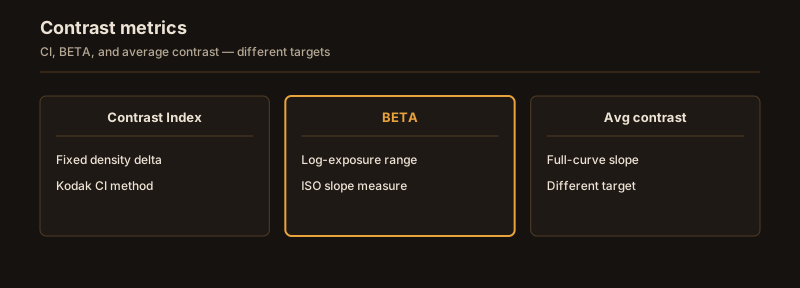
Contrast Index, BETA, and average contrast name different targets
Sets Kodak F-4017’s numeric Contrast Index 0.56 starting-point claim, J-86’s 0.60-for-T-MAX-400 / 0.56-for-other-films split under T-MAX Developers, J-109’s CI-column matrix (0.56 on Kodak box-speed rows; 0.58 on Ilford box-speed rows under XTOL), F-4016/F-4043’s non-numeric diffusion-enlarger contrast wording, ADOX CHS 100 II’s BETA 0.65 medium-contrast column, and Ilford FP4 Plus / HP5 Plus qualitative “average contrast” language side by side as incompatible published contrast-target kinds of claim.
“Normal,” “medium,” and “average” contrast on manufacturer film and developer sheets do not name one shared target. Kodak’s TRI-X sheet states a Contrast Index of 0.56. Kodak’s T-MAX Developer sheet states 0.60 for T-MAX 400 and 0.56 for the other films. Kodak’s XTOL sheet puts CI numbers in a table column and assigns 0.56 to Kodak box-speed rows while assigning 0.58 to Ilford box-speed rows. Kodak’s T-MAX film sheets drop the number and keep only diffusion-enlarger wording. ADOX publishes BETA 0.65 as medium contrast. Ilford’s FP4 Plus and HP5 Plus sheets publish “average contrast” with no numeric metric. Collapsing those usages into one “normal contrast” invents a common kind of claim the documents do not share.
This article is a dated contrast-target vocabulary matrix. It is not a development recipe, and it does not choose a contrast aim for any film or enlarger.
The claim-class matrix
| Document | Date / identity | What the starting-point / timetable claim is | Numeric contrast metric on that claim | Stated printing / purpose framing |
|---|---|---|---|---|
| KODAK PROFESSIONAL TRI-X 320 and 400 Films, F-4017 | December 2016 (Revised 12-16) |
Starting-point recommendations “intended to produce a contrast index of 0.56” | Contrast Index 0.56 | Make tests for the application; CI curves appear later on the sheet |
| KODAK PROFESSIONAL T-MAX Developers, J-86 | December 2017 (Revised 12-17) |
Starting-point times “intended to produce a contrast index of 0.60 for KODAK PROFESSIONAL T-MAX 400 Film and 0.56 for the other films” | Contrast Index 0.60 (T-MAX 400) / 0.56 (other films named on that sheet) | “contrast suitable for printing with a diffusion enlarger”; condenser path is a time reduction, not a second CI number |
| KODAK PROFESSIONAL XTOL Developer, J-109 | February 2018 | Small-tank (and other) tables carry an explicit CI column beside EI | Kodak box-speed rows in Table 1 use 0.56 (e.g. TRI-X 400 at EI 400/800; T-MAX 100 at EI 100/200; T-MAX 400 at EI 400); Ilford box-speed rows on the same table use 0.58 (e.g. FP-4 Plus at EI 125; HP-5 Plus at EI 400) | Features line: “Contrast Index similar to that produced by other developers”; no Ilford-sheet citation for the 0.58 assignments |
| KODAK PROFESSIONAL T-MAX 100 Film, F-4016 | June 2018 (Revised 6-18) |
Starting-point recommendations “intended to produce negatives with a contrast appropriate for printing with a diffusion enlarger” | No “contrast index of …” number in the PROCESSING starting-point paragraph; extract contains no 0.56 / 0.60 target string |
Condenser path points to “Adjusting Film Contrast”; CI appears as curve axes later, not as the starting-point number |
| KODAK PROFESSIONAL T-MAX 400 Film, F-4043 | February 2016 | Same diffusion-enlarger starting-point sentence as F-4016 | No “contrast index of …” number in that paragraph; extract contains no 0.56 / 0.60 target string |
Same condenser pointer pattern; CI curves later; does not reprint J-86’s 0.60 claim |
| ADOX CHS 100 II technical information | 14 Oct 2020 | Timetable aimed at “a medium contrast of 0,65”; column headed BETA | BETA 0.65 on the medium-contrast rows; one SILVERMAX row prints 0.70 with ISO 125/22° | Sheet does not define BETA as Contrast Index, gamma, or average gradient |
| ILFORD FP4 Plus / HP5 Plus technical information | Nov 2018 | Development times “will produce negatives of average contrast suitable for printing in all enlargers” | None on those sheets | Times are a guide; adjust if a different result is needed; no CI / BETA / G-bar symbol |
What each publication is actually attaching to “normal”
Kodak sometimes publishes a Contrast Index number, and not always the same one. F-4017’s PROCESSING block is unambiguous: the starting-point recommendations are intended to produce CI 0.56. J-86, for T-MAX Developer and T-MAX RS tables, splits the number by film: 0.60 for PROFESSIONAL T-MAX 400 Film and 0.56 for the other films on that sheet. Those are developer-sheet claims under named T-MAX developers, not a silent rewrite of F-4017.
J-109 publishes CI as a table coordinate, including for films whose makers never print CI. In Table 1 (small tanks), the Kodak box-speed lines cited above sit at CI 0.56, while the Ilford FP-4 Plus EI 125 and HP-5 Plus EI 400 lines sit at CI 0.58. That 0.58 is Kodak’s XTOL-table assignment. It is not a quotation of Ilford’s November 2018 FP4 Plus or HP5 Plus sheets, which contain no Contrast Index figure.
Kodak’s T-MAX film sheets refuse the number in the starting-point prose. F-4016 and F-4043 use the same sentence: contrast “appropriate for printing with a diffusion enlarger.” They do not say “contrast index of 0.56” or “0.60.” F-4043 therefore does not carry, on that film sheet, the 0.60 figure J-86 attaches to T-MAX 400 under T-MAX developers. CI curves on those film sheets show Contrast Index as a plotted axis; they are not a substitute for a missing starting-point CI sentence.
ADOX names BETA and equates medium contrast to 0.65. The sheet’s own words are “a medium contrast of 0,65” with a BETA column. European decimal commas print 0,65 / 0,70. That two-page technical information does not define the geometric construction of BETA and does not call it Contrast Index.
Ilford names average contrast and stops. FP4 Plus and HP5 Plus both say the published times produce “average contrast suitable for printing in all enlargers.” There is no numeric target beside that phrase on those sheets.
Why the targets do not collapse
A shared “normal contrast” reading would need a shared metric name, a shared number (or a shared rule that maps names to numbers), and a shared document role for that number. These sheets disagree on all three.
- Metric name: Contrast Index (Kodak), BETA (ADOX), or an unquantified “average contrast” (Ilford).
- Number: Kodak’s own sources already contain 0.56, 0.58, and 0.60 in different document roles; ADOX’s medium figure is 0.65 BETA; Ilford prints no number.
- Document role: film-sheet starting-point claim (F-4017), developer-sheet starting-point claim (J-86), developer-table CI column that also numbers other makers’ films (J-109), film-sheet qualitative diffusion claim with CI only on curves (F-4016 / F-4043), manufacturer timetable column (ADOX), and qualitative film-sheet aim (Ilford).
- J-86’s 0.60 for T-MAX 400 under T-MAX developers and J-109’s 0.56 for T-MAX 400 under XTOL are different developer publications. They are not proof that one sheet misprinted the other; they are proof that “the” Kodak CI for that film is not one published number across those sheets.
- Kodak’s assignment of CI 0.58 to Ilford box-speed rows in J-109 is not Ilford’s published average-contrast claim, and Ilford’s silence on CI is not a Kodak CI of 0.56.
What a citation has to carry is therefore the kind of claim, the product or developer publication, and the revision: numeric CI on a named sheet, CI as a table column (including whose film row), qualitative diffusion-enlarger contrast, BETA, or unquantified average contrast. A bare “develop to normal contrast” with no kind of claim attached is not a usable quotation of these documents. Speed vocabulary on the same film sheets is a parallel claim-class matrix; see ISO and EI name different claims on published film sheets. J-86’s dual T-MAX 100 product-line rows sit on the same starting-point tables as those CI figures; see J-86 keeps two T-MAX 100 time rows under different names.
References
- KODAK PROFESSIONAL TRI-X 320 and 400 Films, Kodak Alaris, publication F-4017, December 2016 (
Revised 12-16) — https://imaging.kodakalaris.com/sites/default/files/files/products/f4017_trix_320400.pdf - KODAK PROFESSIONAL T-MAX Developers, Kodak Alaris, publication J-86, December 2017 (
Revised 12-17) — https://www.kodakprofessional.com/sites/default/files/wysiwyg/pro/chemistry/j86.pdf - KODAK PROFESSIONAL XTOL Developer, Kodak Alaris, publication J-109, February 2018 — https://www.kodakprofessional.com/sites/default/files/wysiwyg/pro/chemistry/J-109_Feb_2018.pdf
- KODAK PROFESSIONAL T-MAX 100 Film, Kodak Alaris, publication F-4016, June 2018 (
Revised 6-18) — https://www.kodakprofessional.com/sites/default/files/wysiwyg/pro/resources/f4016_TMax_100.pdf - KODAK PROFESSIONAL T-MAX 400 Film, Kodak Alaris, publication F-4043, February 2016 — https://www.kodakprofessional.com/sites/default/files/wysiwyg/pro/resources/f4043_TMax_400.pdf
- ADOX CHS 100 II B/W Film technical information, ADOX Fotowerke GmbH; “14. Okt. 2020” — https://www.fotoimpex.com/shop/images/products/media/43100_5_PDF-Datasheet.pdf
- ILFORD FP4 Plus technical information, HARMAN technology Limited; footer “Page 1 of 6 Nov 2018” — archived Ilford manufacturer download — https://web.archive.org/web/20260214104258id_/https://www.ilfordphoto.com/amfile/file/download/file/1919/product/690/; manufacturer PDF — https://www.ilfordphoto.com/amfile/file/download/file/1919/product/690/
- ILFORD HP5 Plus technical information, HARMAN technology Limited; footer “Page 1 of 6 Nov 2018” — archived Ilford manufacturer download — https://web.archive.org/web/20260214104308id_/https://www.ilfordphoto.com/amfile/file/download/file/1903/product/695/; manufacturer PDF — https://www.ilfordphoto.com/amfile/file/download/file/1903/product/695/
Share