Process control
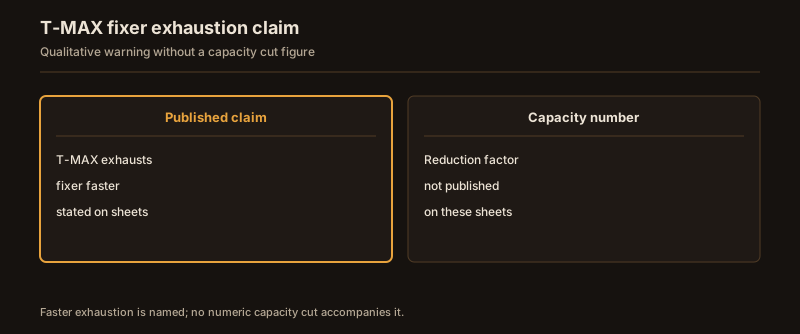
T-MAX exhausts fixer faster — no capacity cut in these Kodak sheets
Sets Kodak F-4016 for T-MAX 100 (June 2018), Kodak ED-BWF (March 2023), and the retailer-hosted Kodak Rapid Fixer pack-in (code 20370811, © Kodak 2015) in one source matrix that separates the qualitative faster-exhaustion warning, the longer T-MAX fixing time, and the generic 120-roll capacity / 10 mL-per-roll replenishment figures, and records that these sources supply no T-MAX-specific numerical capacity or replenishment adjustment.
Kodak publishes a plain warning that T-MAX work exhausts fixer faster than other films. The same sources also publishes a longer T-MAX fixing time, one film capacity of 120 rolls per gallon, and one replenishment rate of 10 mL per roll. What it does not publish, in these three documents, is a T-MAX-specific number that would turn “more rapidly” into a capacity cut, a silver threshold, a percentage reduction, or a different replenishment figure.
This article is a source matrix of those three Kodak documents. It reports what each sheet says and what scope it carries. It is not a fixing, reuse, replenishment or disposal guide, and it does not treat the Rapid Fixer pack-in as current.
Three documents, three jobs
| F-4016, T-MAX 100, June 2018 | ED-BWF, March 2023 | Kodak Rapid Fixer pack-in, code 20370811, © Kodak 2015 | |
|---|---|---|---|
| Document class | Film technical data sheet for one product | Family processing overview for Kodak Professional black-and-white films | Retailer-hosted one-page pack-in for Kodak Rapid Fixer |
| Exhaustion wording | “Your fixer will be exhausted more rapidly with these films than with other films.” | “With KODAK PROFESSIONAL T-MAX Films, fixer will be exhausted more rapidly than with other films.” | No exhaustion warning on that sheet |
| Scope of that wording | Subject of the sheet is T-MAX 100; plural grammar alone does not widen the claim to the family | Explicit family wording for Kodak Professional T-MAX Films | Not applicable |
| Fixing time stated here | Rapid Fixer: 3–5 minutes at 18–24°C with vigorous / frequent agitation | Generic liquid-concentrate fixer: approximately 2–4 minutes; footnote says times are approximate and to refer to film or developer instructions | Fresh manual bath, frequent agitation, 18–24°C: most Kodak professional films 2–4 minutes; Kodak T-MAX Professional Films 3–5 minutes |
| Capacity | Not published on this film sheet | Not published | One value: 120 135-size 36-exposure rolls (or 120 8×10 sheets) per 3.8 L / 1 gallon |
| Replenishment | Not published on this film sheet | Not published | One value: 10 mL per roll for all tank sizes |
| T-MAX-specific numerical capacity or replenishment cut | Absent | Absent | Absent: no T-MAX footnote, capacity row, percentage, silver threshold, or replenishment adjustment |
The useful comparison is the matrix, not a single “Kodak says” sentence. Each figure belongs to a dated document with its own subject and its own silence.
Scope is not interchangeable
F-4016 June 2018 is the technical data sheet for KODAK PROFESSIONAL T-MAX 100 Film. On page 4, under FINAL STEPS, it gives Rapid Fixer as 3 to 5 minutes at 65 to 75°F (18 to 24°C) with vigorous agitation and an instruction to agitate frequently during fixing. The Important note then warns that fixer will be exhausted more rapidly “with these films” than with other films. The sheet’s subject is T-MAX 100. The plural phrase is not, by itself, evidence that the same sentence was written as a family-wide claim in this publication.
ED-BWF March 2023 is the document that supplies family wording. On page 2, in the Final Steps table, it states that with Kodak Professional T-MAX Films, fixer will be exhausted more rapidly than with other films. That is a broader subject than F-4016’s T-MAX 100 sheet, and it should be cited as the family statement rather than inferred from F-4016’s grammar.
The Rapid Fixer pack-in is a different document class again: a one-page instruction sheet identified by code 20370811 and © Kodak 2015, retrieved here from a retailer host rather than from a Kodak technical-data URL. It separates fixing times — most Kodak professional films 2–4 minutes, Kodak T-MAX Professional Films 3–5 minutes — and then publishes one capacity and one replenishment figure with no T-MAX-specific footnote under either.
Two specifications, not one mechanism
The longer T-MAX fixing time and the faster-exhaustion warning coexist in this set. They are separate published specifications.
F-4016 and the Rapid Fixer pack-in both give T-MAX Rapid Fixer work a 3–5 minute band under the agitation and temperature conditions each sheet states. ED-BWF’s 2–4 minute liquid-fixer band is marked approximate and explicitly defers to film or developer instructions, so it is not a rival clock that overturns the 3–5 minute film and pack-in figures. The same F-4016 final-steps block attaches “twice the time it takes for the film to clear” only to non-Rapid fixers; see “Twice the clearing time” names three published rules.
None of the three documents says that the longer fixing time is what causes faster exhaustion. None supplies iodide content, emulsion structure, silver-load arithmetic, diffusion language, or any other causal mechanism for the exhaustion warning. The magenta (pink) stain note on F-4016 and ED-BWF is diagnostic only in the narrow sense those sheets give: stain after fixing may mean the fixer is near exhaustion, or the fixing time was too short. No causal path from stain chemistry to bath loading is stated.
Treating the time band as an explanation of the exhaustion sentence, or inventing a mechanism to join them, goes past the documents.
The number that is not there
After the qualitative warning and the longer time, a reader looking for an operational adjustment reaches the Rapid Fixer pack-in’s capacity and replenishment lines. Those lines are generic:
- Capacity: 120 135-size, 36-exposure rolls, or 120 8×10-inch sheets, per 3.8 litres / 1 gallon of fixing bath.
- Replenishment: 10 mL per roll for all tank sizes.
There is no second capacity row for T-MAX, no footnote cutting 120, no percentage reduction, no silver-concentration threshold, and no T-MAX-specific replenishment adjustment on that sheet. F-4016 and ED-BWF warn about faster exhaustion and do not replace those missing numbers.
The bounded negative result is therefore narrow. In this three-source set, Kodak publishes the qualitative warning and the longer T-MAX fixing time while retaining one capacity figure and one replenishment figure. These sources do not supply a T-MAX-specific numerical bridge from “more rapidly” to a revised roll count or replenishment rate. That generic 120-roll label is the same figure Capacity labels cannot rank rapid fixers compares across brands, and Ilford publishes silver ceilings Kodak’s pack-in lacks; see What fixer exhaustion actually means.
That is a documented missing bridge inside these files. It is not proof that Kodak never published such a number elsewhere, not an estimate of a safe T-MAX capacity, and not a recommendation to cut 120 by any amount.
What the matrix supports
The source matrix supports three checkable claims: which document carries which wording, which document carries which fixing-time band, and that the Rapid Fixer pack-in’s capacity and replenishment figures remain unadjusted for T-MAX in that sheet. It does not support a derived T-MAX working capacity, a causal story linking time to exhaustion, or a claim that the 2015 pack-in is the current Kodak Rapid Fixer instruction.
References
- KODAK PROFESSIONAL T-MAX 100 Film, Kodak Alaris, publication F-4016, June 2018 (
Revised 6-18) — https://www.kodakprofessional.com/sites/default/files/wysiwyg/pro/resources/f4016_TMax_100.pdf - Processing KODAK PROFESSIONAL Black-and-White Films, Kodak Alaris, publication ED-BWF, March 2023 (
Revised 3-23) — https://www.kodakprofessional.com/sites/default/files/wysiwyg/pro/resources/edbwf_0.pdf - KODAK RAPID FIXER instruction sheet (pack-in), Kodak Alaris; © Kodak 2015; code 20370811; one page — retailer-hosted public copy https://www.freestylephoto.com/static/pdf/product_pdf/kodak/KODAK_RAPID_FIXER_INSTRUCTIONS.pdf
Share