Developer and fixer chemistry
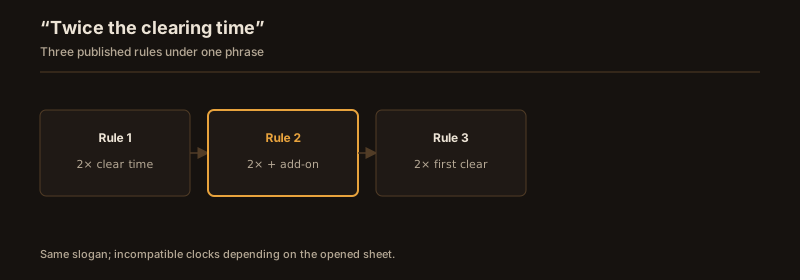
“Twice the clearing time” names three published rules
Separates three manufacturer rules that the field collapses into one phrase: Ilford Rapid Fixer (July 2010) and Hypam (August 2002) each publish a drop-test fixing-time rule (remain in fixer for twice the clearing time) and a separate discard rule (discard when used clearing exceeds twice fresh clearing); Kodak F-4016 for T-MAX 100 (June 2018) attaches “twice the time it takes for the film to clear” to non-Rapid fixers while giving Rapid Fixer an absolute 3–5 minute band and a mid-fix clearing check after three minutes; and Kodak ED-BWF (March 2023) and J-109 (February 2018) restate a generic twice-clearing instruction without Ilford’s drop-test method or discard threshold.
Ask how long to fix film and the answer often arrives as one phrase: twice the clearing time. That phrase is real. It is also not one rule. On the manufacturer sheets below it names a fixing-time multiplier defined by a drop test, a separate bath-discard threshold that uses the same multiplier word, and a Kodak path that keeps the twice language for non-Rapid fixers while Rapid Fixer gets an absolute clock and a mid-fix check. The dated sheets are the evidence — not a fixing, reuse or disposal guide, and none is treated as current beyond the revisions named in the references.
Ilford publishes two ×2 rules on one page
Ilford Rapid Fixer, July 2010, under Film clearing time, states both:
- Film should remain in the fixer for twice the time it takes the emulsion to clear.
- Fixer should be discarded when the clearing time in used fixer exceeds twice the clearing time in fresh fixer.
The same pair appears on Ilford Hypam, August 2002, in the same section title and the same order. One ×2 sets immersion time. The other ×2 retires the bath. Collapsing them into “when clearing doubles, you’re done” erases which clock the phrase is answering.
Both sheets then define the measurand. Clearing time is not the time for a drop to clear a spot. The method is: place a drop of working-strength fixer on scrap unprocessed film until that spot is clear (the sheets say this should take around 30 to 60 seconds); immerse the piece in the bath; time how long the rest of the film takes to match the clear central spot. That immersion interval is the clearing time. “The fixing time needed is double the clearing time.”
That drop-test definition is what carries both Ilford ×2 rules. It is also what What fixer exhaustion actually means uses when it describes the clearing-time test as a fixing-time instrument. What that article does not separate — and what this one is for — is the second ×2 on the same page, and how Kodak’s sheets place the twice language.
Rapid Fixer’s average-minimum table still sits beside those rules: general-purpose film at 1+4, fresh fixer, 20°C, average minimum 2–5 minutes. The clearing rules do not delete that band. They are a parallel activity check, not a substitute label for the table.
Kodak F-4016 scopes “twice clearing” away from Rapid Fixer
Kodak publication F-4016 for T-MAX 100, June 2018, under FINAL STEPS, does not apply the twice phrase to Rapid Fixer the way Ilford applies it to Rapid Fixer and Hypam.
The Rapid path is an absolute band: fix at 65 to 75°F (18 to 24°C) for 3 to 5 minutes with vigorous agitation in Kodak Rapid Fixer, with frequent agitation during fixing. The sheet then says it strongly recommends Rapid Fixer to keep fixing times short. Only after that fork does the twice language appear: if you use another fixer, such as Kodak Fixer or KODAFIX Solution, fix for 5 to 10 minutes or twice the time it takes for the film to clear.
So on this film sheet, “twice the time it takes for the film to clear” is attached to the non-Rapid alternative. It is not the published Rapid Fixer clock. The February 2016 manufacturer revision of the same publication carries the same Rapid / non-Rapid split and the same twice attachment.
F-4016 also publishes a mid-fix inspection that is not Ilford’s drop test: “You can check the film for clearing after 3 minutes in KODAK Rapid Fixer or 5 minutes in KODAK Fixer or KODAFIX Solution.” That sentence times when an in-process look is allowed. It does not define clearing time by a scrap-film drop, does not say to double the observed clearing interval for Rapid Fixer, and does not publish Ilford’s used-versus-fresh discard threshold. The same F-4016 final-steps block also warns that T-MAX exhausts fixer faster without publishing a capacity cut; see T-MAX exhausts fixer faster — no capacity cut in these Kodak sheets.
ED-BWF and J-109 keep a generic twice without the Ilford apparatus
Two other Kodak process sheets restore a twice instruction as a general final-step line, and still do not supply Ilford’s method pair.
ED-BWF, March 2023, tabulates approximate liquid-concentrate fixing at 2:00 to 4:00 and powder fixing at 5:00 to 10:00, marks those times approximate, and tells the reader to see the specific fixer. In the same Fix row it also says: “Fix for twice as long as it takes the film to clear (lose its milky appearance). See instructions for the specific fixer.” The milky-appearance gloss is whole-film language. The sheet does not reprint Ilford’s drop-test procedure, and it does not state a discard rule keyed to twice the fresh clearing time.
J-109 for XTOL, February 2018, is shorter still. Its final-steps table gives Stop Bath 30 seconds, then Fixer “Twice as long as it takes the film to clear (lose its milky appearance); see the specific film or fixer instructions.” The twice line is a pointer out of the developer sheet, not a self-contained drop-test or discard specification.
Read against F-4016, those generic lines are incomplete without the film or fixer sheet they defer to. For T-MAX 100 on F-4016, the Rapid path they might be thought to govern is the 3–5 minute band, not an unbound twice-clearing multiplier.
| Ilford Rapid Fixer, July 2010 / Hypam, August 2002 | Kodak F-4016, T-MAX 100, June 2018 | Kodak ED-BWF, March 2023 / J-109, February 2018 | |
|---|---|---|---|
| Twice as fixing-time rule | Yes: remain in fixer for twice emulsion clearing time | Yes, but scoped to non-Rapid fixers (Fixer / KODAFIX), as “5 to 10 minutes or twice…” | Yes, as a generic final-step line that defers to film or fixer instructions |
| Twice as bath-discard rule | Yes: discard when used clearing exceeds twice fresh clearing | Not published on this sheet | Not published on these sheets |
| How clearing time is defined | Drop on scrap film, then timed immersion of the rest against the clear spot | Not defined; mid-fix “check … for clearing after” 3 minutes (Rapid) or 5 minutes (other named fixers) | “Lose its milky appearance” gloss only; no drop-test method |
| Rapid / ammonium path clock published here | Average minimum table (Rapid: 2–5 minutes at 1+4, 20°C, fresh) beside the clearing rules | Absolute 3–5 minutes for Kodak Rapid Fixer | ED-BWF approximate 2–4 minutes liquid / 5–10 powder; J-109 has no absolute fixer band of its own |
Three ×2 rules, not one multiplier
None of these documents ranks Ilford’s drop-test clock against Kodak’s absolute Rapid band, or proves that a milky-appearance observation equals the Ilford immersion interval after a clear spot. None of the Kodak sheets republishes Ilford’s used-versus-fresh discard threshold. Silver-concentration discard limits and residual-thiosulfate permanence criteria are different kinds of claim and are handled elsewhere on this site; they are not hidden inside the twice phrase.
So a quoted “twice the clearing time” needs the product sheet, which ×2 it is (fixing time or discard), whether the path is Rapid or not on F-4016, and whether clearing was defined by Ilford’s drop test, by Kodak’s milky-appearance line, or by a mid-fix check after a stated number of minutes.
References
- ILFORD Rapid Fixer technical information sheet, HARMAN technology Limited; footer “Page 5 of 5 July 2010”; archived Ilford manufacturer download — https://web.archive.org/web/20260210013708id_/https://www.ilfordphoto.com/amfile/file/download/file/1833/product/711/; additional public mirror — https://assets.website-files.com/5ba2689b2e7121210bfa9af3/5c0ecc53472033a2b1b17efb_tech%20specs%20ilford%20rapid%20fixer.pdf
- ILFORD HYPAM FIXER & HARDENER fact sheet, August 2002 revision (footer
02033.www August 2002), 7 pages — https://web.archive.org/web/20030811061427/http://www.ilford.com/html/us_english/pdf/hypam.pdf, captured 11 August 2003; manufacturer endpoint https://www.ilfordphoto.com/amfile/file/download/file/1866/product/1728/ - KODAK PROFESSIONAL T-MAX 100 Film, Kodak Alaris, publication F-4016, June 2018 (
Revised 6-18) — https://www.kodakprofessional.com/sites/default/files/wysiwyg/pro/resources/f4016_TMax_100.pdf - KODAK PROFESSIONAL T-MAX 100 Film, Kodak Alaris, publication F-4016, February 2016 (
Revised 2-16) — https://business.kodakmoments.com/sites/default/files/files/products/f4016_TMax_100.pdf - Processing KODAK PROFESSIONAL Black-and-White Films, Kodak Alaris, publication ED-BWF, March 2023 (
Revised 3-23) — https://www.kodakprofessional.com/sites/default/files/wysiwyg/pro/resources/edbwf_0.pdf - KODAK PROFESSIONAL XTOL Developer, Kodak Alaris, publication J-109, February 2018 — https://www.kodakprofessional.com/sites/default/files/wysiwyg/pro/chemistry/J-109_Feb_2018.pdf
Share