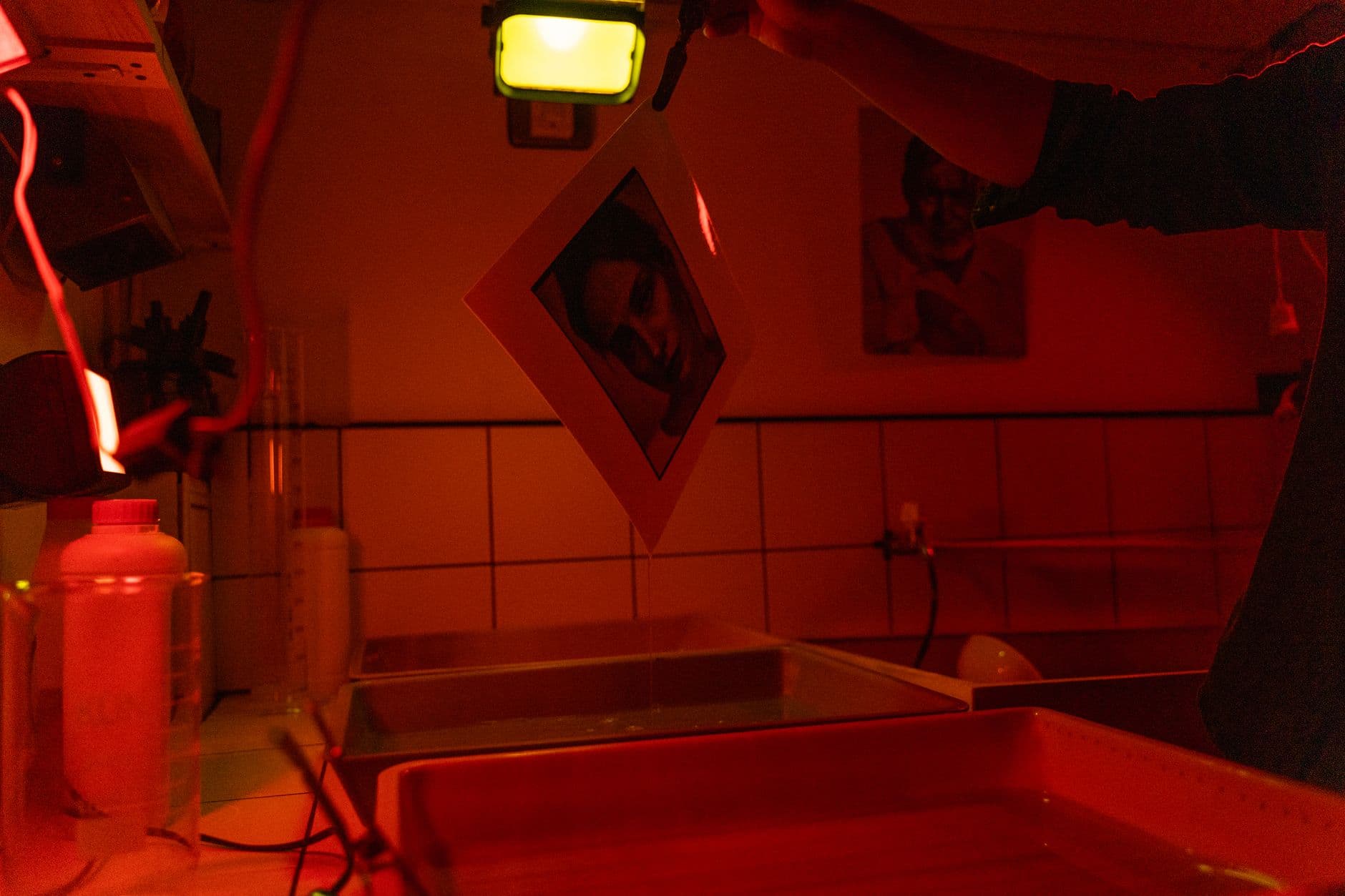
Developer and fixer chemistry
What fixer exhaustion actually means
Records that the 40-print capacity figure on Ilford's own fixer sheets is identical to the commercial-permanence limit printed two pages later, so following it gives four times the silver the same document allows for archival work; reconciles the differing silver thresholds Ilford publishes across its product sheets; separates the three darkroom tests that community advice routinely conflates; and replaces "archival" with the two standards that actually apply — ISO 18901 for film and ISO 18929 for prints — showing that what fixing and washing control is residual thiosulfate in the material, not silver concentration in the bath.
Ask when a fixing bath is finished and you get a number: twenty-four rolls per litre, or forty prints, or whenever the clearing test slows down. Each is defensible. They also disagree with each other by more than an order of magnitude, and two separate confusions are responsible. The first is that "exhausted" describes several different thresholds. The second is that three distinct tests get treated as interchangeable when they measure different things.
The thresholds are not one number
Ilford's data sheets for Rapid Fixer and Hypam both state that the silver level in a film fixing bath "can be allowed to rise to 8–10g/l without serious effect." The same sheets set 2 g/l for fibre-based paper where commercial image permanence is required, roughly forty 8×10 FB prints per litre, and 0.5 g/l for prints needing maximum stability in long-term storage, which they put at approximately ten 8×10 prints per litre.
Every Ilford figure in this article is quoted from a specific dated revision, named in the references: Rapid Fixer and Hypam from August 2002, 2000RT from March 2002. No later fact-sheet revision of those products was available to check — archived captures under those product names are safety data sheets rather than fact sheets — so these figures are what Ilford published in 2002. Whether they still hold is outside what those dated sheets can answer.
That is a sixteen- to twentyfold spread inside a single document. Nothing is inconsistent about it, because the figures answer different questions:
- Will the bath still clear the halide? The 8–10 g/l film figure. Above it, fixing slows and eventually becomes incomplete.
- Will a print survive normal handling and display? For FB paper, 2 g/l.
- Will a print survive decades of storage? For FB paper, 0.5 g/l.
The substrate is why these differ. Silver in the bath is not itself what damages an image; what matters is what remains in the material after washing, and that depends on how much the base can absorb and retain. Ilford gives the mechanism for resin-coated paper explicitly: it tolerates higher silver, 4–6 g/l, because the base is sealed on both sides by an impervious polythene coating.
The same manufacturer gives different RC figures
Here the sheets genuinely diverge. Rapid Fixer and Hypam quote 4–6 g/l for RC paper. Ilford's 2000RT sheet, covering machine processing chemistry, states that where a high level of image permanence is required for commercial use, RC silver should be kept below 1 g/l, about twenty 8×10 RC prints per litre.
Both are Ilford, and neither is wrong. They describe different products in different processing contexts, and the 4–6 g/l figure is a tolerance while the 1 g/l figure is a permanence target. This is the practical reason a number is only usable with its product sheet attached. "Ilford says 4–6 g/l for RC" is not a citation; "Ilford Rapid Fixer data sheet, silver concentration section" is.
One thing the 2000RT sheet does not do is give an archival figure. It states the 4–6 g/l tolerance and the below-1 g/l commercial target, and stops there. Hypam's 0.5 g/l long-term-storage limit is written for FB paper and cannot be carried across to RC on the strength of the two sheets sharing a manufacturer.
Ilford also cautions that print throughput is only a guide, because silver loading depends on the ratio of exposed to unexposed area in what is being fixed. A litre that has processed ten heavily exposed prints is not in the same state as one that has processed ten near-white ones.
The capacity table and the permanence limit are not the same number
This is the part worth knowing, and it is visible inside a single document two pages apart — in both sheets, identically, so it is a feature of how Ilford writes fact sheets rather than a slip in one of them.
Each sheet has a table headed "Capacity without replenishment". For FB paper at 1+4 it gives "40 sheets of 20.3x25.4cm (8x10in)" per litre, with one caveat underneath: "The figures for paper may be exceeded whenever print stability is not critically important."
Two pages later, the silver concentration section gives 2 g/l as the limit for commercial permanence and puts that at "approximately" forty 8×10 FB prints — the same forty. It then gives 0.5 g/l for "prints that need maximum stability for long term storage", at approximately ten.
So the capacity table's headline figure is the commercial threshold. It is not a conservative working number with archival headroom built into it; it is already at the limit for the less demanding of the two permanence cases. Anyone printing for long-term storage who reads the capacity table — the obvious place to look for how many prints a litre will take — and stops there will run four times the silver the same document permits for the job they are doing.
The caveat compounds it by pointing in only one direction. It tells the reader when forty may be exceeded. It never says that forty must be reduced, and the table carries no cross-reference to the section that would tell them so.
None of this is an error on Ilford's part. Every figure is correct and each is answering the question asked in its own section. It is a reminder that a manufacturer's capacity number answers "when does this bath stop working", and that is a different question from "when does this bath stop being good enough for what I am doing".

Three tests, three different jobs
Community advice tends to collapse these. They are not substitutes.
The clearing-time test measures fixer activity and sets fixing time. Place a drop of working-strength fixer on a piece of scrap unprocessed film until a clear spot appears, then immerse the film and time how long the rest of the emulsion takes to clear to match. Ilford's instruction is that total fixing time is double the clearing time. This tells you how long to fix in the bath you have. It does not tell you the silver concentration, and it does not tell you whether a finished negative is archivally sound.
Silver estimator papers measure bath silver concentration. Useful for confirming a bath is within a commercial range. Ilford states plainly that they "are usually not sensitive enough to test the very low silver levels suitable for optimum permanence," which rules them out for the 0.5 g/l case — the one where the answer actually matters.
The sulphide test checks whether a finished print was adequately fixed. It is applied to a processed and thoroughly washed print, not to the bath. A reference tint is established on a print known to be well fixed and washed, and later prints showing yellowing against that reference are not properly fixed. Ilford is explicit that prints must be well washed first and that the test "is not effective on prints direct from the fixer bath."
That last test uses a sodium sulphide solution, which is genuinely hazardous: sulphides liberate hydrogen sulphide on contact with acid, and darkroom fixers are acidic. The preparation procedure is in Ilford's data sheet and is deliberately not reproduced here; anyone intending to perform it should work from the manufacturer's document and the current Safety Data Sheet for the specific sodium sulphide product, and not near working acidic baths.
Why the film capacity figure is not an archival number
Ilford's stated capacity for Rapid Fixer at 1+4 is 24 rolls of 135-36 per litre of working-strength solution, and a 5-litre bottle of concentrate is quoted as fixing 600 films, 2000 8×10 RC prints, or 1000 8×10 FB prints.
The twenty-four-roll figure is a fixing-performance capacity, sitting inside the 8–10 g/l tolerance band for film baths. It is not derived from an archival criterion, because for film the archival criterion is not bath silver at all.
What the archival criterion actually is
Start with the word itself, because the standards have abandoned it. ISO 18901 records that "in the past, the term 'archival' was used to define material that could be expected to preserve images forever, this is now a deprecated term and is no longer used in International Standards for imaging materials." What replaced it is the life expectancy rating: LE-100 means the information is predicted to remain retrievable after at least 100 years, in dark storage, under specified conditions. It is a prediction about a system, not a property a bottle of fixer can confer.
Two standards apply here, and the near-universal error is to use the film one for prints.
Film: ISO 18901
ISO 18901 covers processed silver-gelatin black-and-white films — its scope says so, and prints are outside it. It sets limits on residual thiosulfate retained in the film, measured by the methods of ISO 18917, expressed per side of the film.
The thing to know before quoting any number from it is that there is no single set of three limits. The standard sorts film into three classes and gives each its own figures, with two or three life expectancy tiers depending on the class. Summarising what it specifies, in grams of thiosulfate ion per square metre:
- Ordinary pictorial film — the class the standard calls "other films", and the one that covers everything a darkroom worker is likely to handle — is allowed 0.100 at LE-10, 0.050 at LE-100 and 0.014 at LE-500.
- Radiographic film shares the first two figures but is held to 0.020 at LE-500, not 0.014.
- Microfilm is stricter at the middle tier, 0.030 rather than 0.050, and has no LE-10 tier at all.
So the triple 0.100 / 0.050 / 0.014, which is what usually gets quoted as "the ISO 18901 limits", is accurate for one class of the three and wrong for the other two. Since the standard's own conversion is 0.010 g/m² = 1 µg/cm², the pictorial LE-500 figure is 1.4 µg/cm². The LE label attached to those cells is not interchangeable across film and print standards; see LE-100 residual thiosulfate is not one ceiling.
The strictest of those figures has an independent, freely readable confirmation that does not depend on the standard itself. The US National Archives requires in regulation, at 36 CFR § 1238.14(c), that agencies "process microforms so that the residual thiosulfate ion concentration will not exceed 0.014 grams per square meter in accordance with ISO 18901." That is public-domain law citing the same standard, and it is a useful thing to know exists — it means the number can be checked by anyone without going near a paywall.
One qualification on LE-500 matters more than its placement in a footnote suggests: it is available only to polyester-base film. No amount of washing earns an acetate-base film a 500-year rating.
Prints: ISO 18929, and the numbers do not carry over
Reflection prints are covered by ISO 18929, and it is built differently. There is one limit, 0.014 g/m², and it is the same for fibre-base and RC prints. There is no ladder — a print meeting the standard is rated LE-100, and that is the ceiling.
The test method differs too, and this is the part that trips up anyone reasoning across from film. ISO 18929 permits only the iodine amylose method for prints, and states that "the methylene blue method shall not be used because it fails to detect residual thiosulfate in RC-base prints." Methylene blue is fine for film and is what Kodak's own analytical method uses. On an RC print it can return a clean result from a print that is not clean.
Three consequences, all of which cut against common practice
More washing is not monotonically better. Both standards carry the same caution in the same words: a very low concentration of thiosulfate due to excessive washing may make the silver image more susceptible to oxidative attack, and such concentrations may fall below what ISO 18917 can detect. In ISO 18901 it sits in a footnote to Table 2 itself, directly beneath the limits. There is a target band, not a race to zero. Washing to zero is not what the standards ask for develops that floor, the detection-limit point, and the hypo-clearing versus hypo-eliminator split in full. ISO 18901 also prohibits hypo-eliminating agents containing oxidising agents such as peroxides or hypochlorites — worth knowing given how casually "hypo eliminator" gets recommended — while distinguishing them from hypo-clearing baths, which are high-ionic-strength salt solutions that speed washing without chemically altering the thiosulfate.
Meeting the thiosulfate limit is necessary, not sufficient. It is one clause among many. The same standard separately requires that processed film show no more than a 0.02 increase in Status A blue density from residual silver compounds, and imposes free-acid, tensile, layer-adhesion, emulsion-flow, blocking and image-stability requirements, with storage conditions treated as normative rather than advisory. A negative that clears the hypo limit and fails on retained silver has no LE rating. Residual silver on film is a densitometric cap, not the same measurand as on prints; see Residual silver is a density limit on film and a mass limit on prints. So the honest form of the claim is not that permanence is residual thiosulfate. It is that residual thiosulfate in the material — not silver in the bath — is the part of permanence that fixing and washing actually control.
No bath test measures any of it. Retained thiosulfate is a property of the processed material, determined by fixation and washing together: bath condition, fixing time, emulsion structure, wash sequence and any subsequent treatment all contribute. Bath silver concentration is a convenient sink-side proxy for one input to that outcome, not a measurement of it.
Kodak's process documentation approaches the same problem from the industrial end. Silver is not allowed to accumulate to a discard point at all: continuous electrolytic recovery holds the fixer at 0.5 to 1.0 g/l, with tailing reducing it to 0.1 g/l electrolytically and around 1 mg/l by metallic replacement. For results rather than baths, Kodak specifies residual thiosulfate in micrograms per square centimetre by Analytical Method ULM-0004/1, a methylene blue procedure, and reports 0.2 to 0.4 µg/cm² from a four-stage countercurrent wash.
One Kodak figure needs handling with care rather than merging. The threshold of 4 µg/cm² or greater causing "serious dye fading" appears in the context of Process ECN-2, a colour negative motion-picture process, and describes damage to dyes rather than to a silver image. It should not be carried across to silver-gelatin work as if it were the same limit. The black-and-white numbers are the ISO 18901 values above.
What follows
- Decide which threshold applies before choosing a discard point. Film, RC and FB are three different cases, and archival intent moves the number by an order of magnitude.
- Cite the product sheet, not the manufacturer. Ilford's own RC guidance differs between Rapid Fixer and 2000RT because the products and contexts differ.
- Treat 24 rolls per litre as the fixing-performance capacity it is published as.
- Match the test to the question: clearing time for how long to fix, estimator papers for commercial bath range only, the sulphide test for whether a washed print was adequately fixed.
- For film permanence, work to the ISO 18901 limit for your film class and intended life expectancy rating — 0.050 g/m² gets ordinary pictorial film to LE-100 — and remember that overwashing carries its own risk.
- Do not carry the film ladder across to prints. Prints have one limit, 0.014 g/m², identical for fibre and RC, and LE-100 is the ceiling.
- Stop saying "archival". The standards dropped the word because nothing lasts forever, and a life expectancy rating names the storage assumptions that the word conceals.
The deflating conclusion is that most of the widely repeated numbers are correct and are answering a question other than the one being asked.
Dated 2002 Ilford sheets, not later revisions
Every Ilford figure here belongs to a dated 2002 revision. No later technical-sheet revision could be obtained: at publication the manufacturer's document endpoints were unavailable, while the archive captures under those product names were safety sheets rather than technical sheets. The article therefore says what Ilford published in 2002, not what an inaccessible current document might say. That is a limitation on the claim and a further example of the documentation problem the article describes.
The operative clauses of ISO 18901 and ISO 18929 are available in free previews hosted by standards resellers rather than by ISO. They were read directly, but the hosts and URLs are outside this publication's control. The current federal microform rule is cited alongside them where it corroborates the 0.014 g/m² figure, giving readers a public-domain route to that number without pretending the regulation covers the other film classes or print cases.
The standards' tables and footnotes are summarised rather than reproduced. The arrangement and comparison here are original; the standards' text remains copyrighted even where its publisher or a reseller makes a preview freely readable.
References
- ILFORD RAPID FIXER fact sheet, August 2002 revision (footer
02034.www August 2002), 5 pages — archived copy https://web.archive.org/web/20240906191531if_/https://www.freestylephoto.com/pdf/product_pdfs/ilford/IlfordRapidFixer.pdf; manufacturer endpoint https://www.ilfordphoto.com/amfile/file/download/file/1833/product/711/ - ILFORD HYPAM FIXER & HARDENER fact sheet, August 2002 revision (footer
02033.www August 2002), 7 pages — https://web.archive.org/web/20030811061427/http://www.ilford.com/html/us_english/pdf/hypam.pdf, captured 11 August 2003; manufacturer endpoint https://www.ilfordphoto.com/amfile/file/download/file/1866/product/1728/ - ILFORD 2000RT DEVELOPER/REPLENISHER & FIXER/REPLENISHER fact sheet, March 2002 revision (footer
02049.www March 2002), 4 pages — https://web.archive.org/web/20030403184959/http://www.ilford.com/html/us_english/pdf/2000RT.pdf, captured 3 April 2003; manufacturer endpoint https://www.ilfordphoto.com/amfile/file/download/file/594/product/569/ - ISO 18901:2010, Imaging materials — Processed silver-gelatin-type black-and-white films — Specifications for stability — catalogue entry https://www.iso.org/standard/51029.html. Clauses 1–7 including Table 2 are reproduced in the free preview at https://cdn.standards.iteh.ai/samples/51029/98eeb0c2dc1944c8ad8ac647494eea22/ISO-18901-2010.pdf
- ISO 18929:2012, Imaging materials — Wet-processed silver-gelatin type black-and-white photographic reflection prints — Specifications for dark storage — catalogue entry https://www.iso.org/standard/55696.html. Free preview including Clause 6.1 at https://preview.sist.si/sist-preview/55696/9fabc925198b4de5ad1999feb80d8d44/ISO-18929-2012.pdf
- ISO 18917:1999, Determination of residual thiosulfate and other related chemicals in processed photographic materials — https://www.iso.org/standard/28235.html
- 36 CFR § 1238.14, US National Archives and Records Administration, microform processing requirements — https://www.law.cornell.edu/cfr/text/36/1238.14
- Processing KODAK Motion Picture Films, Module 5 — https://www.kodak.com/content/products-brochures/Film/Processing-KODAK-Motion-Picture-Films-Module-5.pdf
- Processing KODAK Motion Picture Films, Module 7 — https://www.kodak.com/content/products-brochures/Film/Processing-KODAK-Motion-Picture-Films-Module-7.pdf
- Kodak Analytical Method ULM-0004/1, residual thiosulfate as methylene blue — https://125px.com/docs/motionpicture/misc/ulm0004-1.pdf
Share