Archival permanence
Residual silver is a density limit on film and a mass limit on prints
Separates residual silver across the film and print standards: ISO 18901:2010 Clause 6.5 caps residual silver compounds by a Status A blue density increase of 0,02 under a densitometric test, while ISO 18929:2012 Clause 6.2 caps residual silver concentration at 0,025 g/m² by atomic absorption — same everyday label, different property names, units, and methods — and records that HARMAN / Ilford’s December 2017 Chemical Sundries sheet keeps “residual silver” as the qualitative “adequately fixed” half of optimum permanence without printing either figure.
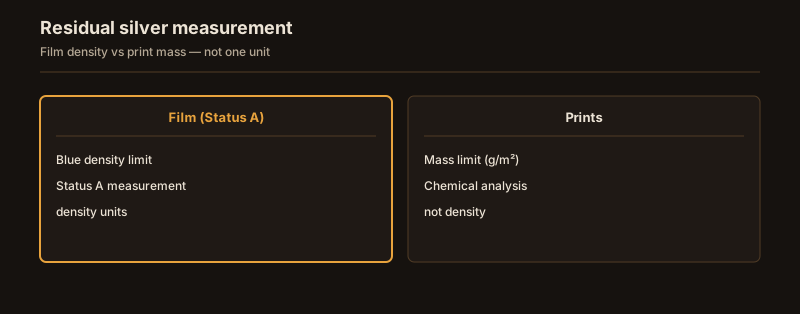
“Residual silver” sounds like one archival number. On the film and print standards it is not. One document limits a densitometric density change; the other limits a mass of silver per square metre. A manufacturer permanence page that uses the same phrase prints neither figure. The comparison below is of kinds of residual-silver claim in two ISO texts, with one Ilford sheet as a third, non-numeric use of the label — not a fixing recipe, a spot-test procedure, or a measurement of any particular negative or print.
Film: residual silver compounds as a density increase
ISO 18901:2010, Imaging materials — Processed silver-gelatin-type black-and-white films — Specifications for stability, second edition, 2010-05-01, puts residual silver under Clause 6.5, titled Residual silver compounds:
Processed film shall not show more than an increase of 0,02 in Status A blue density when tested in accordance with 8.9 (see Annex C).
The free preview states the limit and names the test clause. It does not reproduce the unpaid Clause 8.9 procedure body. What the requirement itself carries is enough for the comparison: residual silver on film is framed as compounds, judged by a Status A blue densitometric increase of at most 0,02, not as grams per square metre.
That residual-silver clause sits next to, and apart from, Table 2’s residual-thiosulfate ceilings. The thiosulfate table is LE-tiered by film class; Clause 6.5 is a single densitometric cap in that text. LE-100 residual thiosulfate is not one ceiling already separates those thiosulfate cells. The point here is only that residual silver on film is a different measurand from residual thiosulfate — and a different kind of claim from residual silver on prints.
Prints: residual silver concentration as grams per square metre
ISO 18929:2012, Imaging materials — Wet-processed silver-gelatin type black-and-white photographic reflection prints — Specifications for dark storage, second edition, 2012-04-01, puts residual silver under Clause 6.2, titled Residual silver concentration:
The processed print shall not contain more than 0,025 g/m² of silver when tested in accordance with 8.4.3 or 8.5.3 using the atomic absorption technique.
Again the free preview states the limit and names the test clauses. The table of contents labels those methods “Residual silver compound test using cyanogen iodide (CNI) extraction” and “Residual silver compound test by use of sulfuric acid/nitric acid extraction”; the normative ceiling itself is a mass concentration of silver, 0,025 g/m², by atomic absorption. Clause 7 then awards LE rating 100 to prints that meet all the specifications in the standard — residual thiosulfate, residual silver, yellowing, and the physical clauses together. Residual silver is therefore part of the print LE-100 package, but it is not the familiar 0,014 g/m² thiosulfate figure treated in the companion residual-thiosulfate article.
Read side by side with Clause 6.5 of the film standard, the everyday phrase “residual silver” attaches to:
| Source and residual-silver definition | Clause title | Limit as written | Method named in the limit clause |
|---|---|---|---|
| ISO 18901:2010 §6.5 | Residual silver compounds | ≤ 0,02 Status A blue density increase | Clause 8.9 (Annex C) |
| ISO 18929:2012 §6.2 | Residual silver concentration | ≤ 0,025 g/m² silver | Clauses 8.4.3 or 8.5.3, atomic absorption |
Same conversational label. Different property name in the clause title, different unit, different analytical path. Neither limit converts into the other without a method and a calibration the standards do not supply in these clauses.
Ilford’s optimum-permanence page keeps the label qualitative
HARMAN technology’s Sundry chemicals for processing black and white films and papers fact sheet, footer-updated December 2017, defines optimum permanence for fibre-based papers without either ISO figure:
Essentially, prints must have minimum levels of residual silver (adequately fixed) and minimum levels of thiosulphate (adequately washed).
That sheet does not print 0,02, 0,025 g/m², Status A, or atomic absorption next to that residual-silver half. “Adequately fixed” is the manufacturer’s gloss for the residual-silver side of optimum permanence; it is not a bridge that makes the film densitometric limit and the print mass limit the same number. Sequences on that page that implement the permanence wording are already compared elsewhere for wash times and for toner roles; they are not revisited here as process instructions.
Same label, three incompatible senses
| What this page claims | What “residual silver” is on that page |
|---|---|
| ISO 18901:2010 §6.5 | Residual silver compounds; densitometric ΔD ≤ 0,02 Status A blue |
| ISO 18929:2012 §6.2 | Residual silver concentration; ≤ 0,025 g/m² silver by atomic absorption |
| Ilford Chemical Sundries, Dec 2017 | Minimum residual silver = “adequately fixed”; no numeric ISO residual-silver limit |
These previews do not make the film densitometric test and the print atomic-absorption test interchangeable, and they do not state a conversion between 0,02 density increase and 0,025 g/m². Silver concentration in a fixer bath, treated on manufacturer capacity pages in grams per litre, is a different kind of claim again and is not used here to rank either material limit.
Saying two materials were checked for “residual silver” does not, on these texts, say they were judged by the same property, unit, or method — and a manufacturer permanence page that names residual silver without either ISO figure does not supply the missing bridge.
References
- ISO 18901:2010, Imaging materials — Processed silver-gelatin-type black-and-white films — Specifications for stability, second edition, 2010-05-01; Clause 6.5 (residual silver compounds; Status A blue density increase of 0,02; test per 8.9 / Annex C) and Table 2 context for residual thiosulfate as a separate requirement — catalogue entry https://www.iso.org/standard/51029.html; free preview reproducing Clause 6.5 at https://cdn.standards.iteh.ai/samples/51029/98eeb0c2dc1944c8ad8ac647494eea22/ISO-18901-2010.pdf
- ISO 18929:2012, Imaging materials — Wet-processed silver-gelatin type black-and-white photographic reflection prints — Specifications for dark storage, second edition, 2012-04-01; Clause 6.2 (residual silver concentration ≤ 0,025 g/m² by atomic absorption via 8.4.3 or 8.5.3), Clause 7 (LE rating 100), and table-of-contents labels for Clauses 8.4–8.5 — catalogue entry https://www.iso.org/standard/55696.html; free preview at https://preview.sist.si/sist-preview/55696/9fabc925198b4de5ad1999feb80d8d44/ISO-18929-2012.pdf
- HARMAN technology Limited, Sundry chemicals for processing black and white films and papers, Updated: Dec 2017; “Optimum permanence for fibre based papers” (minimum residual silver as “adequately fixed”) — archived Ilford manufacturer download — https://web.archive.org/web/20250516164800id_/https://www.ilfordphoto.com/amfile/file/download/file/1865/product/669/; additional public mirror — https://www.fomei.com/editor/image/eshop_products_files/5630/Pomocne_lazne_technical%20data%20sheet.pdf
Share