
Archival permanence
LE-100 residual thiosulfate is not one ceiling
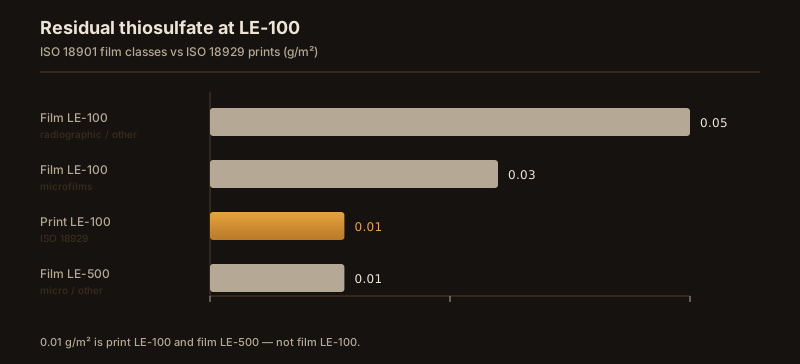
Separates the residual-thiosulfate ceilings attached to LE-100 across the film and print standards: ISO 18929:2012 sets a single 0,014 g/m² limit for fibre-base and RC prints that earn an LE rating of 100, while ISO 18901:2010 Table 2 sets film LE-100 at 0,050 g/m² for radiographic and “other” films and at 0,030 g/m² for microfilms — and the familiar 0,014 g/m² figure appears on that film table as the microfilm and other-films LE-500 cells (radiographic LE-500 is 0,020), so quoting 0,014 as “the LE-100 residual” collapses print LE-100 with film LE-500.
LE-100 looks like a shared residual-chemistry target. On the film and print standards it is not. The same label attaches different maximum residual-thiosulfate concentrations depending on which document and which film class you open — and the number most often treated as “the archival residual,” 0,014 g/m², is print LE-100 and film LE-500, not film LE-100. The comparison below is of residual-thiosulfate ceilings next to LE designations in two ISO texts, with the federal microform incorporation as a third attachment of the same 0,014 figure — not a wash recipe, a fixer capacity, or a measurement of any particular negative or print.
Print LE-100 is one residual number
ISO 18929:2012, Imaging materials — Wet-processed silver-gelatin type black-and-white photographic reflection prints — Specifications for dark storage, second edition, 2012-04-01, puts residual thiosulfate in Clause 6.1 and the LE rating in Clause 7.
Clause 6.1 requires that after processing, fibre-base and RC-base black-and-white prints “shall not contain more than 0,014 g/m² of residual thiosulfate,” calculated as thiosulfate ion and measured by the iodine-amylose method in ISO 18917. There is no second print class and no second LE column in that clause: one ceiling for both fibre and RC.
Clause 7 then awards the rating that travels with that package:
Prints that meet all the specifications set forth in this International Standard shall have an LE rating of 100.
So on the print standard, meeting the residual-thiosulfate (and other) specifications is the LE-100 path. There is no LE-500 print designation in that text. The ambient-pair change in how that LE-100 label defines storage conditions is already treated in Print LE-100 no longer names 21 °C and 50 % RH; the point here is only the residual number attached to the rating.
Film LE-100 is three residual numbers, none of them 0,014
ISO 18901:2010, Imaging materials — Processed silver-gelatin-type black-and-white films — Specifications for stability, second edition, 2010-05-01, does not publish one residual ceiling for “film.” Its introduction states that the standard covers three classes — radiographic films, microfilms, and all other films — and that “two or three LE ratings are given for each of these film classes depending on their residual thiosulfate concentrations.”
Clause 6.4 then requires the residual thiosulfate concentration, as thiosulfate ion by an ISO 18917 method, not to exceed Table 2. That table reads:
| Film type | LE designation | Maximum residual thiosulfate (g/m²) |
|---|---|---|
| Radiographic films | LE-10 | 0,100 |
| Radiographic films | LE-100 | 0,050 |
| Radiographic films | LE-500 | 0,020 |
| Microfilms | LE-100 | 0,030 |
| Microfilms | LE-500 | 0,014 |
| Other films | LE-10 | 0,100 |
| Other films | LE-100 | 0,050 |
| Other films | LE-500 | 0,014 |
Footnote a repeats the base rule already used in Federal archival microfilm once allowed cellulose ester or polyester: LE-500 applies only to polyester-base film. Footnote b scopes the values to each side that has a photographic layer or a non-curl backing layer. Footnote c supplies the same unit bridge the print standard uses: 0,010 g/m² = 1 µg/cm².
Read for LE-100 alone, the film table never prints 0,014. Radiographic and “other” films at LE-100 are allowed up to 0,050 g/m². Microfilm at LE-100 is allowed up to 0,030 g/m². Both are higher than the print LE-100 ceiling. The 0,014 g/m² cells on the film table sit under LE-500 for microfilms and for other films. Radiographic LE-500 is 0,020 g/m² — still higher than print LE-100’s 0,014.
So the conversational move “LE-100 means residual thiosulfate at or below 0,014 g/m²” is true for the print standard and false for every LE-100 row on the film table. The number that looks universal is, on film, an LE-500 cell (or, for radiographic film, not even that).
Washing to zero is not what the standards ask for already notes that ISO 18901 tiers film limits by class and life expectancy and that 0,014 g/m² is the print figure and the federal microform figure. The contribution here is the LE-label mismatch those tiers create: same LE-100 string, different residual ceilings, and 0,014 shared by print LE-100 with film LE-500 rather than with film LE-100.
The federal microform rule attaches 0,014 to ISO 18901’s LE-500 cell
36 CFR § 1238.14(c) requires agencies to process microforms so that residual thiosulfate ion concentration “will not exceed 0.014 grams per square meter in accordance with ISO 18901.” Paragraph (b) of the same section requires polyester-based silver-gelatin film conforming to ISO 18901 “for LE 500 film in all applications.”
That pair is internally coherent with Table 2: the microfilm LE-500 residual cell is 0,014 g/m², and the LE-500 base rule is polyester. It is not coherent with reading 0,014 as microfilm LE-100. Microfilm LE-100 on the same table is 0,030 g/m². The federal processing ceiling therefore matches the LE-500 microfilm residual row in the incorporated film standard, not the LE-100 microfilm residual row — another place where the familiar 0,014 figure is doing LE-500 work under ISO 18901 even when everyday speech calls residual limits “archival” without an LE class.
The earlier doubling of that federal ceiling relative to FIPS PUB 82, and the floor-above-zero point, remain in the washing article. This paragraph only places the current 0,014 incorporation against Table 2’s LE columns.
LE-100 does not name one residual ceiling
| Source and residual-thiosulfate figure | Ceiling next to LE-100 / the shared 0,014 figure |
|---|---|
| ISO 18929:2012 §§6.1, 7 | ≤ 0,014 g/m² for FB and RC; meeting the specifications yields LE rating 100 |
| ISO 18901:2010 Table 2, LE-100 rows | 0,050 g/m² (radiographic; other films); 0,030 g/m² (microfilms) — not 0,014 |
| ISO 18901:2010 Table 2, 0,014 cells | Microfilms LE-500; other films LE-500 |
| ISO 18901:2010 Table 2, radiographic LE-500 | 0,020 g/m² |
| 36 CFR § 1238.14(b)–(c) | LE 500 polyester film per ISO 18901; residual ≤ 0.014 g/m² per ISO 18901 |
These previews do not make pictorial camera film and microfilm the same class for residual purposes: camera film falls under “other films” in the film standard’s three-class scheme, and microfilm has its own LE-100 / LE-500 pair. None of this converts any of these ceilings into a wash time, claims that a home process “is LE-100,” or asserts that residual silver limits (a separate measurand in both standards) reconcile the thiosulfate mismatch.
Saying two materials are both “LE-100” does not, on these texts, say they share a residual-thiosulfate ceiling. And saying a process aims at “0,014 g/m² residual” does not, without naming the standard and LE column, say whether that figure is being used as print LE-100 or as film LE-500.
References
- ISO 18901:2010, Imaging materials — Processed silver-gelatin-type black-and-white films — Specifications for stability, second edition, 2010-05-01; introduction (three film classes; LE ratings depending on residual thiosulfate), Clause 6.4 and Table 2 (residual-thiosulfate limits by film type and LE designation, including LE-500 polyester footnote) — catalogue entry https://www.iso.org/standard/51029.html; free preview reproducing those passages at https://cdn.standards.iteh.ai/samples/51029/98eeb0c2dc1944c8ad8ac647494eea22/ISO-18901-2010.pdf
- ISO 18929:2012, Imaging materials — Wet-processed silver-gelatin type black-and-white photographic reflection prints — Specifications for dark storage, second edition, 2012-04-01; Clause 6.1 (≤ 0,014 g/m² residual thiosulfate for fibre-base and RC prints by iodine-amylose / ISO 18917) and Clause 7 (LE rating of 100 for prints meeting the specifications) — free preview at https://preview.sist.si/sist-preview/55696/9fabc925198b4de5ad1999feb80d8d44/ISO-18929-2012.pdf
- 36 CFR § 1238.14, What are the microfilming requirements for permanent and unscheduled records?; paragraphs (b) (polyester-based silver-gelatin conforming to ISO 18901 for LE 500 film) and (c) (residual thiosulfate ion ≤ 0.014 g/m² in accordance with ISO 18901) — https://www.law.cornell.edu/cfr/text/36/1238.14
Share