
Archival permanence
Print LE-100 no longer names 21 °C and 50 % RH
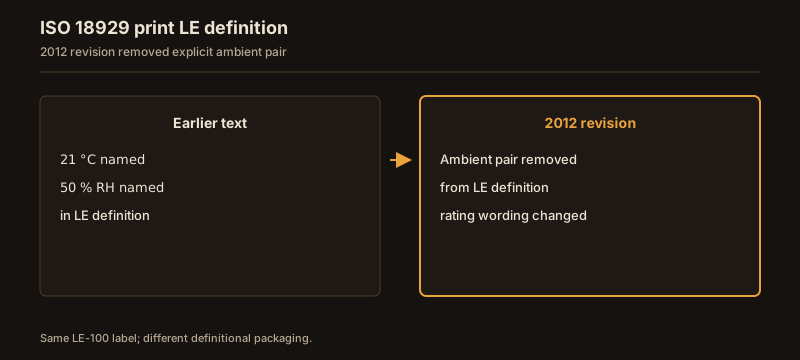
Reconciles ISO 18929:2003, which defined life expectancy and the LE designation by dark storage at 21 °C and 50 % RH — the same ambient pair ISO 18901:2010 still prints for film — with the 2012 second edition of ISO 18929, which replaces those figures with “conditions defined in the relevant standards,” naming ISO 18902 and ISO 18920 in a note, so an LE-100 label for a reflection print under the current print standard is no longer, on the face of that definition, the same storage claim as LE-100 under the film standard or under the prior print edition.
Life expectancy ratings look interchangeable. LE-100 on a film standard and LE-100 on a print standard both say a century of retrievable information. These definitions do not attach the same storage claim to that number. The comparison below is of how three ISO texts define LE — not a storage recipe, a wash sequence, or a measurement of how long any particular print will last.
The film standard still pins 21 °C and 50 % RH
ISO 18901:2010, Imaging materials — Processed silver-gelatin-type black-and-white films — Specifications for stability, second edition, 2010-05-01, splits the idea into two terms. Clause 3.5 defines life expectancy (LE) as:
length of time that information is predicted to be acceptable in a system after dark storage at 21 °C and 50 % relative humidity (RH)
Clause 3.6 then defines the LE designation as a rating of that life expectancy, and its note repeats the ambient pair:
The number following the LE symbol is a prediction of the minimum life expectancy, in years, during which information can be retrieved without significant loss when stored at 21 °C and 50 % RH, e.g. LE-100 indicates that information can be retrieved after at least 100 years of storage.
So on the film standard, the century figure is not a free-floating durability label. The term that carries it names dark storage at a stated temperature and relative humidity. The same standard separately requires films to be stored under ISO 18902 and ISO 18911 (Clause 5.1). That normative storage pointer sits beside the LE definition; it does not replace the 21 °C / 50 % RH wording inside Clauses 3.5 and 3.6.
The 2003 print standard used the same pair
ISO 18929:2003, Imaging materials — Wet-processed silver-gelatin type black-and-white photographic reflection prints — Specifications for dark storage, first edition, 2003-12-01, is the print counterpart. Its Clause 3.3 defines life expectancy in the same shape the film standard still uses:
length of time that information is predicted to be acceptable in a system after dark storage at 21 °C and 50 % RH
A note under that term already points useful life to companion storage documents: “the actual useful life of black-and-white paper is very dependent upon the existing storage conditions (see ISO 18902 and ISO 18920).” Clause 3.4 then defines the LE designation, and its note again states the ambient pair:
The number following the LE symbol is a prediction of the minimum life expectancy in years for which information can be retrieved without significant loss when stored at 21 °C and 50 % RH, for example, LE-100 indicates that the information can be retrieved after at least 100 years storage.
The introduction of the same 2003 edition matches those clauses: life expectancy is “defined as the length of time that information is predicted to be retrievable in a system after storage at 21 °C and 50 % relative humidity (RH).” On that edition, a print LE-100 and a film LE-100 were at least definitionally aligned on the named ambient pair, even though the two standards govern different materials and cite different storage companions (18911 for film storage practice in ISO 18901; 18920 for paper in the print notes).
The 2012 print revision removes the figures
ISO 18929:2012, second edition, 2012-04-01, states in its foreword that it “cancels and replaces the first edition (ISO 18929:2003), which has been technically revised.” The LE vocabulary is where one revision is visible without opening the cancelled annexes.
The 2012 text no longer keeps a separate “life expectancy” duration term and an “LE designation” rating term. Clause 3.3 is titled life expectancy / LE, but its body is the rating wording:
rating for the life expectancy of recording materials and associated retrieval systems
NOTE 1 under that term is where the century example now lives:
The number following the LE symbol is a prediction of the minimum life expectancy in years for which information can be retrieved without significant loss when stored in the conditions defined in the relevant standards. For example, LE-100 indicates that the information can be retrieved after at least 100 years storage.
The 21 °C and 50 % RH figures are not in that note. They are not elsewhere in the 2012 preview’s LE introduction either: the introduction now defines life expectancy as retrievability “after storage,” with no ambient pair. NOTE 2 under Clause 3.3 keeps the companion-standard pointer that 2003 already had — useful life “is very dependent upon the existing storage conditions (see ISO 18902 and ISO 18920)” — but that pointer is no longer paired with a numeric temperature and humidity inside the LE definition itself.
Read against ISO 18901:2010, the current print definition and the current film definition therefore disagree about what LE-100 says on its face. Film LE still names 21 °C and 50 % RH. Print LE under the 2012 edition names “conditions defined in the relevant standards.” Read against ISO 18929:2003, the print standard disagrees with its own prior edition on the same point: the ambient pair was present; the revision that cancelled 2003 removed it from the definitional text while retaining the ISO 18902 / ISO 18920 cross-reference.
Print LE no longer states the ambient pair
| Document | How LE-100’s storage claim is written in the definition |
|---|---|
| ISO 18901:2010 §§3.5–3.6 | Dark storage at 21 °C and 50 % RH, stated in the term and in the LE-designation note |
| ISO 18929:2003 §§3.3–3.4 | Same ambient pair in the term and in the LE-designation note; useful-life note also cites ISO 18902 and ISO 18920 |
| ISO 18929:2012 §3.3 | “Conditions defined in the relevant standards”; NOTE 2 cites ISO 18902 and ISO 18920; no 21 °C / 50 % RH in that LE text |
The 2012 preview was searched for the film standard’s ambient strings in the LE sense: it does not contain “21 °C” or “50 % RH” as LE storage conditions. That is a negative result about this preview’s definitional wording, not a claim about every clause of the paid full text.
ISO 18902 and ISO 18920 are outside this set. The article therefore does not assert what temperature or humidity those documents set, and it does not claim that 2012 silently moved the 21 °C / 50 % RH pair into them. What these sources support is narrower: the print LE definition stopped stating that pair, while the film LE definition still states it, and the 2003 print edition had stated it too.
None of this converts an LE rating into a wash time, a fixer capacity, or a room-conditioning instruction. It only keeps the label honest. Saying two materials are both “LE-100” is not, in these texts, the same as saying their governing standards attach the same named storage conditions to that rating — or the same residual-thiosulfate ceiling; see LE-100 residual thiosulfate is not one ceiling. Residual limits and wash advice are a separate kind of claim again; see Washing to zero is not what the standards ask for.
References
- ISO 18901:2010, Imaging materials — Processed silver-gelatin-type black-and-white films — Specifications for stability, second edition, 2010-05-01; Clauses 3.5–3.6 (life expectancy and LE designation at 21 °C / 50 % RH) and Clause 5.1 (storage under ISO 18902 and ISO 18911) — catalogue entry https://www.iso.org/standard/51029.html; free preview reproducing those clauses at https://cdn.standards.iteh.ai/samples/51029/98eeb0c2dc1944c8ad8ac647494eea22/ISO-18901-2010.pdf
- ISO 18929:2003, Imaging materials — Wet-processed silver-gelatin type black-and-white photographic reflection prints — Specifications for dark storage, first edition, 2003-12-01; introduction and Clauses 3.3–3.4 (life expectancy and LE designation at 21 °C / 50 % RH; useful-life note citing ISO 18902 and ISO 18920) — catalogue entry https://www.iso.org/standard/31954.html; free preview at https://cdn.standards.iteh.ai/samples/31954/33614239de7d4407a9675cb4a15df352/ISO-18929-2003.pdf
- ISO 18929:2012, Imaging materials — Wet-processed silver-gelatin type black-and-white photographic reflection prints — Specifications for dark storage, second edition, 2012-04-01; foreword (cancels and replaces 2003), introduction, and Clause 3.3 Notes 1–2 (LE under “conditions defined in the relevant standards”; ISO 18902 and ISO 18920) — catalogue entry https://www.iso.org/standard/55696.html; free preview at https://preview.sist.si/sist-preview/55696/9fabc925198b4de5ad1999feb80d8d44/ISO-18929-2012.pdf
Share