
Archival permanence
Federal archival microfilm once allowed cellulose ester or polyester
Reconciles FIPS PUB 82 (1980), adopting NMA MS1-1980, which classified archival silver-gelatin microfilm by reference to either the cellulose-ester archival film specification (ANSI PH1.28) or the polyester archival film specification (ANSI PH1.41), with current 36 CFR § 1238.14(b), which requires polyester-based silver-gelatin film conforming to ISO 18901 for LE 500 film in all applications — matching ISO 18901’s rule that LE-500 applies only to polyester-base film and that cellulose-ester film tops out at LE-100 — a base-material change that arrived by standards incorporation rather than as an announced processing revision.
The residual-thiosulfate ceiling for permanent federal microform doubled between FIPS PUB 82 and today’s 36 CFR § 1238.14, as washing to zero is not what the standards ask for records. The same pair of documents also disagrees about something easier to miss: which film base could carry the archival / long-life rating.
This is a provenance comparison of those base rules. It is not a storage recipe, a film-buying guide, or a claim about pictorial camera film outside the microform standards named below.
FIPS 82 accepted either cellulose ester or polyester
In September 1980 the US National Bureau of Standards issued FIPS PUB 82, adopting the National Micrographics Association practice MS1-1980 for alphanumeric computer-output microfilm. Section 5.1 defines archival microforms as records for permanent storage — “Archival is considered forever or permanent” — and then states how silver-gelatin film qualifies. Only wet-processed silver-gelatin films “may be considered archival,” and classification requires the film to meet one of two ANSI specifications named with their full titles:
Specifications for Photographic Film for Archival Records, Silver-Gelatin Type, on Cellulose Ester Base, or … Specifications for Photographic Film for Archival Records, Silver-Gelatin Type, on Polyester Base
The document cites those titles as ANSI PH1.28 and PH1.41 (the PDF text layer renders the committee numeral as “PHI”), and additionally requires processing and storage under the archival conditions of ANSI PH1.43. The conjunction that matters for base material is the “or.” Permanent classification under that federal specification could ride on the cellulose-ester archival film specification or the polyester archival film specification. The same section then adds the residual-thiosulfate ceiling and floor, and names the methylene-blue method — points already treated in the washing article. The base clause is independent of those figures: two ANSI film-for-archival-records specifications, distinguished in their titles by cellulose ester versus polyester, both open as routes to archival classification.
Earlier in the same adopted practice, section 3’s general description of microfilm construction says the flexible base “may be either acetate or polyester.” That sentence is about what microfilm stock is made of, not a second permanence rule. The archival gate itself is the dual citation in section 5.1.
FIPS 82 is not current law. NIST withdrew it on 29 May 1996, recorded at 61 FR 26891. It is quoted here as evidence of what was specified in 1980, not as a present requirement.
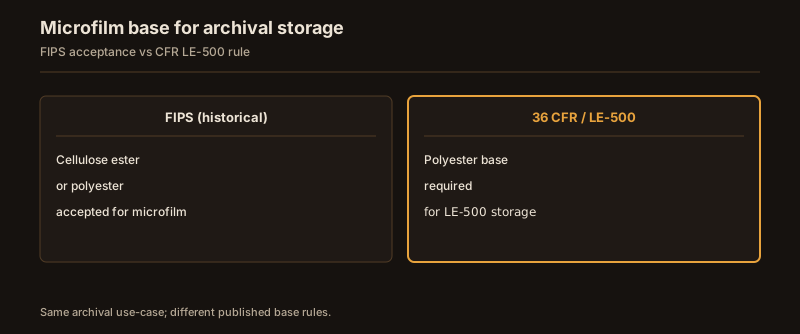
The current rule attaches LE-500 to polyester
The microfilming requirements for permanent and unscheduled federal records now sit at 36 CFR § 1238.14. Paragraph (b) states:
Agencies must use polyester-based silver gelatin type film that conforms to ISO 18901 (incorporated by reference, see § 1238.5) for LE 500 film in all applications.
The scope of that sentence is LE 500 film, not an undefined “archival” bottle claim. Within that scope the base is no longer a choice between cellulose ester and polyester: polyester is required, and the film must conform to ISO 18901. Paragraph (c) separately sets the residual-thiosulfate ceiling at 0.014 g/m² by the same ISO 18901 incorporation — the processing figure that replaced FIPS 82’s 0.7 µg/cm² ceiling. The base rule and the residual rule travel together by reference update; neither paragraph announces that an earlier dual-base archival path has been closed.
The regulation does not, in the text of § 1238.14, write a separate cellulose-ester archival option parallel to FIPS 82’s PH1.28 route. What it does write for the LE-500 case is polyester plus ISO 18901.
ISO 18901 is why the dual path cannot survive at LE-500
ISO 18901:2010, Imaging materials — Processed silver-gelatin-type black-and-white films — Specifications for stability, still admits both safety bases. Clause 4 requires record-film base to be “a safety polyester or a cellulose-ester type,” then states the life-expectancy cap that makes the federal LE-500 sentence make sense:
Some films on a cellulose-ester-type base can have a maximum LE rating of 100. Some films on a polyester base can have a maximum LE rating of 500.
Table 2’s residual-thiosulfate limits repeat the same constraint as a footnote to every LE-500 cell: “LE-500 film only applies to polyester-base film.” The standard’s introduction supplies the historical reason in summary form: cellulose-ester safety bases were the commercial norm from about 1908 to 1956, with useful-life discussion in the fifty-to-one-hundred-year band under proper storage, while polyester safety base entered commercial use in 1956 and is the class for which the standard publishes a 500-year LE tier.
So the current CFR sentence is not inventing a polyester preference in a vacuum. It names the only base on which ISO 18901’s LE-500 designation is available. FIPS 82’s “archival forever” framing, which could be satisfied through either the cellulose-ester or the polyester ANSI archival-film specification of its day, does not map onto that LE-500 cell. A cellulose-ester film that met every other ISO 18901 requirement in that standard would still be capped at LE-100 under Clause 4.
What changed, and what did not
Three documents, read side by side:
| Document | Status in this comparison | Base rule for the long-life / archival case named in that document |
|---|---|---|
| FIPS PUB 82 / NMA MS1-1980 §5.1 | Historical federal specification (withdrawn 1996) | ANSI PH1.28 (cellulose ester) or PH1.41 (polyester) |
| 36 CFR § 1238.14(b) | Current federal microfilming rule for permanent and unscheduled records | Polyester-based silver-gelatin conforming to ISO 18901, for LE 500 film |
| ISO 18901:2010 Clause 4 and Table 2 note | Incorporated standard behind the current rule | Both bases admitted; LE-500 only on polyester; cellulose-ester maximum LE-100 |
The residual-thiosulfate number moved as well, and that movement is already documented. The base movement is the companion fact: the 1980 archival classification offered two ANSI film specifications distinguished by base; the current LE-500 federal sentence offers one base, aligned with the ISO life-expectancy cap.
What these sources do not establish should stay outside the claim. It does not measure how long any particular roll will last. It does not say pictorial camera film is governed by 36 CFR § 1238.14. It does not convert ISO’s LE prediction — dark storage at 21 °C and 50 % RH — into a wash-time or fixer-capacity instruction. And it does not assert a global origin story for “polyester is archival”; it shows only that these federal and ISO texts disagree across time about whether cellulose ester remained an open path to the longest named rating.
References
- FIPS PUB 82, Guideline for Inspection and Quality Control for Alphanumeric Computer-Output Microforms, National Bureau of Standards, September 1980, adopting NMA MS1-1980; section 5.1 (archival classification citing ANSI PH1.28 or PH1.41) and section 3 (acetate or polyester as microfilm base materials) — https://doi.org/10.6028/nbs.fips.82 and https://nvlpubs.nist.gov/nistpubs/Legacy/FIPS/fipspub82.pdf
- NIST, Withdrawn FIPS by Numerical Order Index, recording FIPS 82 withdrawn 1996-05-29 at 61 FR 26891 — https://www.nist.gov/system/files/documents/2016/12/15/withdrawn_fips_by_numerical_order_index.pdf
- 36 CFR § 1238.14, What are the microfilming requirements for permanent and unscheduled records?, paragraphs (a)–(c) — https://www.law.cornell.edu/cfr/text/36/1238.14
- ISO 18901:2010, Imaging materials — Processed silver-gelatin-type black-and-white films — Specifications for stability; Clause 4 (base requirements and LE caps), Table 2 footnote a (LE-500 polyester-only), and introduction (cellulose-ester and polyester base history) — catalogue entry https://www.iso.org/standard/51029.html; free preview reproducing those clauses at https://cdn.standards.iteh.ai/samples/51029/98eeb0c2dc1944c8ad8ac647494eea22/ISO-18901-2010.pdf
Share