Process control
Kodak XTOL “adjusted” 15% makes the total increase 32.25%
Records that Kodak J-109’s full-strength unreplenished XTOL time-compensation ladder applies the second 15% increase to the already adjusted time, so the total increase becomes +32.25% (1.3225× normal, not +30%), and records that F-4016 June 2018 defers to J-109 for detailed XTOL instructions while F-4043 February 2016 contains neither the ladder nor a J-109 pointer.
Kodak publication J-109 for XTOL Developer prints a three-band time-compensation table for full-strength developer under normal, unreplenished processing. The middle band increases the normal time by 15%. The last band increases the adjusted time by 15%. That wording is a calculation instruction, not a synonym for “another 15% of the original.” This article works that arithmetic and checks where two T-MAX film sheets surface — or do not surface — the dependency. It is not a reuse recipe, and it does not treat any of these revisions as current.
What J-109 prints
In the February 2018 Kodak Professional J-109, under Using Full-Strength Developer, the capacity of full-strength XTOL with normal, unreplenished processing is approximately 15 rolls of 135-36 or 120 film (or the equivalent of 80 square inches / 516 cm²) per litre, with time compensation. The same section says to discard the developer after 15 rolls per litre.
The time-compensation table on that page is:
| Rolls per litre | Development-time increase (as printed) |
|---|---|
| 1 to 5 | Use normal development time |
| 6 to 10 | Increase normal development time by 15 percent |
| 11 to 15 | Increase adjusted development time by 15 percent |
The same operative ladder — normal / adjusted, 15% then 15%, discard after 15 rolls per litre — appears in the March 2008 J-109 hosted on a Kodak Moments business domain and in an April 1998 J-109 third-party mirror at 125px.com. The 1998 file is not a manufacturer-hosted download; it is cited only as dated evidence that the wording predates the later revisions. No official erratum changing this ladder was found in the sources examined for this article.
Why “adjusted” is multiplicative
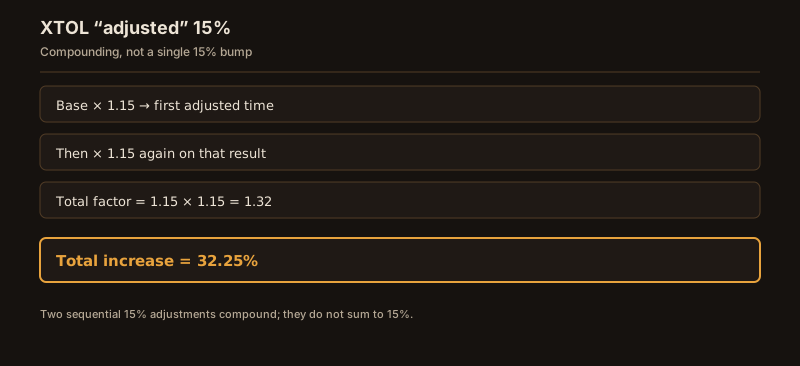
Let (T_0) be the normal development time for the film and conditions in use.
- Rolls 1–5 per litre: (T = T_0)
- Rolls 6–10 per litre: (T = 1.15,T_0)
- Rolls 11–15 per litre: the second increase is applied to the adjusted time, so (T = 1.15 \times (1.15,T_0) = 1.3225,T_0)
That final factor is 132.25% of (T_0): a total increase of 32.25% over (T_0), not 30%. Adding the two 15% increments as if both referred to the original time would understate the final band by 2.25 percentage points relative to the printed rule.
The table does not say “increase normal development time by a further 15 percent” for rolls 11–15. It says “adjusted.” The compounding follows from Kodak’s word choice.
What the ladder does not cover
Two adjacent paths in the same developer publication must stay out of this arithmetic.
XTOL diluted 1:1 is outside the reuse ladder. J-109 February 2018 states that diluted 1:1 solution is for single-use processing, must be discarded after one batch, and must not be reused or replenished. The same exclusion is present in the 2008 and 1998 revisions checked here. F-4016 also leaves T-MAX 100’s small-tank XTOL 1:1 cell blank at 72°F while publishing rotary figures; see F-4016 leaves T-MAX 100’s small-tank XTOL 1:1 cell blank at 72°F. Its rotary roll/sheet split at that dilution is a separate gap; see Two XTOL 1:1 rotary times in Kodak F-4016.
Full-strength replenishment is a separate path. J-109 February 2018 gives a replenishment rate of 70 mL of XTOL Developer as replenisher for each 135-36 or 120 roll (or equivalent area) in systems that use the full-strength solution. That rate is not a substitute for, and must not be blended into, the unreplenished time-compensation bands.
Where the film sheets send a reader
F-4016 for T-MAX 100, June 2018, publishes XTOL starting times and, on page 7, points to Kodak publication J-109 for detailed XTOL processing instructions. It does not restate the time-compensation ladder inline. That is a deferral, not a silent omission or a contradiction of J-109.
F-4043 for T-MAX 400, February 2016, publishes XTOL time tables and the same 70 mL replenishment figure. A complete-document search of that PDF finds no J-109, no Time Compensation, and no 15-roll unreplenished reuse table. That negative result is scoped to this F-4043 revision. It is not a claim that every Kodak film sheet omits the rule.
What a citation has to carry
Anyone quoting “the” XTOL reuse time increase from these documents is quoting a scoped manufacturer rule: full-strength developer, normal unreplenished processing, per-litre roll bands, with the second 15% applied to the already increased time. The cumulative figure for rolls 11–15 per litre is 1.3225× normal (+32.25%). Diluted 1:1 work and replenished full-strength work are different published paths.
The usable contribution is citation discipline: the compounding is in the printed word “adjusted,” F-4016 sends the reader to J-109 for the detail, and at least one film sheet (F-4043 February 2016) neither reprints the ladder nor names J-109.
References
- KODAK PROFESSIONAL XTOL Developer, Kodak Alaris, publication J-109, February 2018 — https://www.kodakprofessional.com/sites/default/files/wysiwyg/pro/chemistry/J-109_Feb_2018.pdf
- KODAK PROFESSIONAL XTOL Developer, Eastman Kodak Company, publication J-109, March 2008 — https://business.kodakmoments.com/sites/default/files/files/resources/j109.pdf
- KODAK XTOL Developer, Eastman Kodak Company, publication J-109, April 1998 (
New 4-98); third-party mirror, not manufacturer-hosted — https://125px.com/docs/techpubs/kodak/j109-1998_04.pdf - KODAK PROFESSIONAL T-MAX 100 Film, Kodak Alaris, publication F-4016, June 2018 (
Revised 6-18) — https://www.kodakprofessional.com/sites/default/files/wysiwyg/pro/resources/f4016_TMax_100.pdf - KODAK PROFESSIONAL T-MAX 400 Film, Kodak Alaris, publication F-4043, February 2016 — https://www.kodakprofessional.com/sites/default/files/wysiwyg/pro/resources/f4043_TMax_400.pdf
Share