
Process control
Two XTOL 1:1 rotary times in Kodak F-4016
Records that Kodak publication F-4016 for T-MAX 100 prints matching roll and sheet times across every shared rotary EI developer row except XTOL 1:1, where three temperatures differ the same way in the June 2018 sheet, the February 2016 sheet, and an October 2007 third-party mirror, so a quoted XTOL 1:1 rotary time is usable only with format and revision attached.
Kodak currently serves two dated revisions of publication F-4016 for T-MAX 100 from two manufacturer domains: June 2018 (Revised 6-18) on kodakprofessional.com, and February 2016 (Revised 2-16) on a Kodak Moments business host. The PDFs are not identical file copies. Their rotary exposure-index tables on page 4 match in the cells that matter here.
Those revision labels do not introduce a second technical time set. After normalizing date and copyright lines, the development and process tables on pages 3–6 and the final-steps, fixing, washing, and storage text read the same in both manufacturer PDFs. The February 2016 file is less reliable for reading graph labels because of font and rendering loss: its page-8 D-76 characteristic-curve legend renders as PL / Q where the June 2018 sheet shows 10 min / 7.5 min / 6 min, and its page-9 contrast-index graphs omit some axis numerals and closing parentheses that the June 2018 PDF renders in the visible packaging. Curve shapes and figure IDs match on visual inspection; that is not a claim that the figure files match byte for byte. The June 2018 page 9 still carries ©2016 under a Revised 6-18 footer. Neither manufacturer PDF contains a changelog or other in-file statement of what the revision label means.
On page 4, under Rotary-Tube Processing—Rolls and Sheets, Kodak prints separate roll and sheet tables of development times in minutes at 65, 68, 70, 72 and 75°F (18, 20, 21, 22 and 24°C). Most shared developer rows agree. One does not — and that split is what this page tracks, not a development recipe or a choice of which row to use.
Shared rows mostly match
Compare only developer rows that appear for both rolls and sheets. Non-RS T-MAX Developer is printed for rolls and is explicitly unsupported for sheet film (“Do not use KODAK PROFESSIONAL T-MAX Developer to process sheet films”), so those roll-only cells are not mismatches.
Across the 2018 and 2016 sheets, the shared rows that match cell-for-cell are:
- T-MAX RS (standard dilution)
- T-MAX RS 1:7
- T-MAX RS 1:9
- XTOL stock
- D-76
- HC-110 (Dilution B)
The only shared EI row that differs is XTOL 1:1.
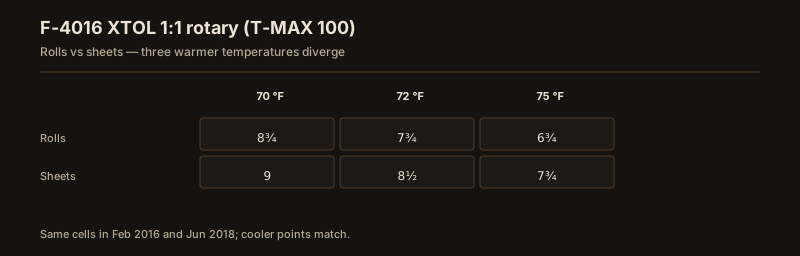
The three temperatures that diverge
For XTOL 1:1, rolls and sheets agree at the two cooler points and diverge at the three warmer ones. The figures are the same in both manufacturer-hosted revisions:
| Temperature | Rolls | Sheets |
|---|---|---|
| 65°F (18°C) | 11¾ min | 11¾ min |
| 68°F (20°C) | 9¾ min | 9¾ min |
| 70°F (21°C) | 8¾ min | 9 min |
| 72°F (22°C) | 7¾ min | 8½ min |
| 75°F (24°C) | 6¾ min | 7¾ min |
That is the whole published difference on the EI rotary table: three temperatures, one dilution, format-labelled columns. The footnotes on page 4 cover standard dilution, dilute-solution caveats, and short-time uniformity. None of them, and none of the surrounding rotary text, states why XTOL 1:1 alone splits this way.
The split is older than the 2016 sheet
A third-party mirror of the combined T-MAX Films F-4016 dated October 2007 (Revised 10-07), hosted at 125px.com rather than by Kodak, already carries the same three-temperature XTOL 1:1 roll/sheet split for T-MAX 100 on its rotary EI tables. That file is not a manufacturer-hosted download; it is cited here only as dated evidence that the pattern predates the February 2016 revision. The 2016 and 2018 manufacturer sheets then reproduce the same cells.
What the push table does not widen
Page 6 of the 2016 and 2018 sheets carries separate rotary push tables for rolls and sheets. On those tables, the XTOL 1:1 roll and sheet values match where both columns publish a figure. That does not explain the EI-table split. It only bounds it: the format divergence on page 4 is isolated to the EI XTOL 1:1 row at 70, 72 and 75°F, not a general rule that every rotary XTOL 1:1 cell differs by format.
These same sheets already publish separate roll and sheet tables for other methods, and they bar non-RS T-MAX Developer from sheet film. That context does not explain the rotary XTOL 1:1 split. No rotary-specific rationale for this row appears in the three documents checked, and no Kodak erratum or later correction of these cells was found in that bounded evidence set.
Format and revision stay attached to the number
Quoting “the” XTOL 1:1 rotary time for T-MAX 100 from F-4016 means quoting one of two published paths. The manufacturer’s own table keeps both. The documents do not say which path is intended when format is omitted, do not mark either path as superseded, and do not supply a mechanism for the three-temperature difference. The small-tank XTOL 1:1 row at 72°F is blank on the same sheet; see F-4016 leaves T-MAX 100’s small-tank XTOL 1:1 cell blank at 72°F.
So the usable statement is narrower than a single number: a quoted XTOL 1:1 rotary time from these sheets needs the format (rolls or sheets) and the revision (at least June 2018, February 2016, or the October 2007 third-party mirror) attached, because Kodak publishes two unexplained paths for that row.
References
- KODAK PROFESSIONAL T-MAX 100 Film, Kodak Alaris, publication F-4016, June 2018 (
Revised 6-18) — https://www.kodakprofessional.com/sites/default/files/wysiwyg/pro/resources/f4016_TMax_100.pdf - KODAK PROFESSIONAL T-MAX 100 Film, Kodak Alaris, publication F-4016, February 2016 (
Revised 2-16) — https://business.kodakmoments.com/sites/default/files/files/products/f4016_TMax_100.pdf - KODAK PROFESSIONAL T-MAX Films, Eastman Kodak Company, publication F-4016, October 2007 (
Revised 10-07); third-party mirror, not manufacturer-hosted — https://125px.com/docs/film/kodak/f4016-TMAX-2007b.pdf
Share