
Process control
J-109’s short-time floor is 4 or 5 minutes by table
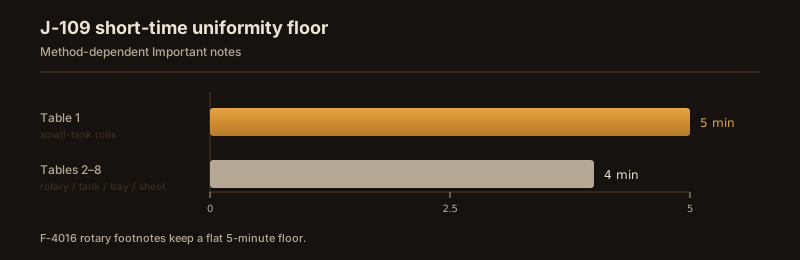
Records that Kodak XTOL publication J-109 sets a method-dependent short-development uniformity floor—5 minutes on small-tank Table 1, 4 minutes on rotary, large-tank, tray and sheet Tables 2–8—while F-4016’s rotary tables (which include XTOL rows and point to J-109 for detailed XTOL instructions) and ED-BWF apply a flat 5-minute floor, so a cited “times shorter than N minutes” warning has to name which publication and which J-109 table.
Kodak’s XTOL developer sheet and Kodak’s film sheets do not share one short-development uniformity floor.
On J-109, the Important note above the small-tank roll table warns below 5 minutes. The Important notes above the rotary, large-tank, tray and sheet tables warn below 4 minutes. On F-4016 for T-MAX 100, the rotary-tube tables that publish XTOL rows use a 5-minute floor and mark sub-five cells with ‡. F-4016 still points readers to J-109 for detailed XTOL instructions and does not reconcile the floors. ED-BWF and J-86 stay with five.
This article compares those published floors. It is not a development recipe, and it does not choose which floor governs a tank.
J-109 splits the floor by table
KODAK PROFESSIONAL XTOL Developer, Kodak Alaris publication J-109, February 2018, places an Important note immediately under each development-time table title:
| J-109 table | Method | Important note |
|---|---|---|
| Table 1 | Roll films, small tanks | Development times shorter than 5 minutes may produce unsatisfactory uniformity. |
| Table 2 | Roll films, rotary tubes | Development times shorter than 4 minutes may produce unsatisfactory uniformity. |
| Tables 3–4 | Roll films, large tanks (seasoned / fresh) | Same 4-minute wording |
| Tables 5–6 | Sheet films, trays / rotary tubes | Same 4-minute wording |
| Tables 7–8 | Sheet films, large tanks (seasoned / fresh) | Same 4-minute wording |
The March 2008 J-109 hosted on a Kodak Moments business domain uses the same per-table split. An April 1998 J-109 third-party mirror at 125px.com is not manufacturer-hosted; it is cited only as dated evidence that the two numbers already coexisted there in combined wording: “Development times shorter than 5 minutes (4 minutes in rotary tubes) may produce unsatisfactory uniformity.” Later revisions separate that parenthetical into table-specific Important notes rather than collapsing to a single floor.
So inside XTOL’s own sheet, “shorter than N minutes” is not one house constant. It is 5 for small-tank rolls and 4 for the other method tables on that sheet.
Film sheets keep five on rotary work
F-4016 for KODAK PROFESSIONAL T-MAX 100 Film / 100TMX, June 2018 (Revised 6-18), does not adopt J-109’s rotary 4-minute floor.
On page 4, under Rotary-Tube Processing—Rolls and again under Rotary-Tube Processing—Sheets, footnote ‡ reads: “Development times shorter than 5 minutes may produce unsatisfactory uniformity.” The same page’s rotary-roll table marks D-76 at 75°F as 4¼‡ and HC-110 (Dilution B) at 72°F / 75°F as 4¾‡ / 4‡. Those cells sit under the film sheet’s five-minute floor. The XTOL stock row on that rotary-roll table reaches exactly 5 minutes at 75°F and is not starred.
Page 6’s push-processing rotary tables repeat the five-minute asterisk language for both rolls and sheets. Page 2’s prose before the small-tank tables says tank development times shorter than 5 minutes may produce unsatisfactory uniformity. February 2016 F-4016 carries the same five-minute rotary and tank wording. F-4043 for T-MAX 400 (February 2016) likewise uses a five-minute floor on its development tables, including rotary and tray blocks; a complete-document search of that F-4043 revision finds no J-109.
None of those film-sheet floors say “except XTOL” or “4 minutes in rotary tubes.”
J-109 publishes T-MAX 100 rotary times under its own 4-minute note
The conflict is not only wording. On J-109 Table 2 (Processing Roll Films in Rotary Tubes), under the 4-minute Important note, KODAK PROFESSIONAL T-MAX 100 Film / 100TMX at EI 25/50, CI 0.52, fresh full-strength developer, 75°F (24°C) is 4¾ minutes. The same row’s fresh 1:1 cell at 80°F (27°C) is also 4¾. Those cells are above J-109’s rotary floor of 4 and below F-4016’s rotary floor of 5.
At the EI 100/200, CI 0.56 line that aligns with F-4016’s normal-speed rotary XTOL cell, J-109’s fresh full-strength 75°F figure is 5 minutes — the value F-4016 also prints for rotary XTOL at 75°F. The sheets agree at that overlapping normal cell. They disagree on which short-time warning attaches to rotary XTOL work, and J-109’s own Table 2 still publishes other T-MAX 100 rotary cells in the open interval between 4 and 5 minutes.
The cross-reference does not close the gap
In F-4016’s contrast-adjustment section (page 7), after describing development-time adjustment factors, the sheet says:
For detailed processing instructions for XTOL Developer, see KODAK PROFESSIONAL XTOL Developer, KODAK Publication No. J-109.
That pointer does not reprint J-109’s table-by-table floors, does not warn that rotary / tray / large-tank XTOL tables use 4 minutes where F-4016’s rotary footnotes use 5, and does not say which Important note survives when both documents are open for one job. F-4016’s deferral to J-109 also leaves a subsequent-agitation conflict unresolved; see Film sheets repeat 5–7 cycles; J-109 uses 2–5 subsequent. The rotary XTOL 1:1 roll/sheet split on F-4016 is another unresolved deferral; see Two XTOL 1:1 rotary times in Kodak F-4016.
Other Kodak sheets stay with five
ED-BWF, Processing KODAK PROFESSIONAL Black-and-White Films, March 2023 (Revised 3-23), puts a single note above its small-tank summary: “Development times shorter than 5 minutes may produce unsatisfactory uniformity.” It does not publish a 4-minute alternate for rotary or any other method.
J-86 for KODAK PROFESSIONAL T-MAX Developers, December 2017 (Revised 12-17), marks short times with a dagger whose gloss is the five-minute uniformity sentence. It does not introduce a four-minute rotary exception.
Those sheets confirm that five remains ordinary Kodak language outside J-109’s non-small-tank tables. They do not erase J-109’s printed 4-minute Important notes.
What a citation has to carry
Anyone quoting Kodak’s “development times shorter than N minutes may produce unsatisfactory uniformity” line from this set is quoting either:
- J-109 Table 1’s 5-minute small-tank floor,
- J-109 Tables 2–8’s 4-minute floor for rotary, large-tank, tray or sheet methods, or
- a film / summary sheet’s flat 5-minute floor (F-4016 rotary and tank wording; F-4043; ED-BWF; J-86’s dagger gloss),
and, for XTOL on T-MAX 100, may also be pointing across F-4016’s J-109 cross-reference without a published reconciliation of those N values.
No sheet in this set states that one floor supersedes the other, explains why small-tank XTOL keeps five while other XTOL methods use four, or authorises reading F-4016’s ‡/asterisk five-minute language as if it were J-109 Table 2’s four-minute Important note. Treating “the Kodak short-time warning” as a single number, or importing a 4¾-minute J-109 rotary cell under F-4016’s five-minute rotary footnote without naming both documents, goes past the sources.
References
- KODAK PROFESSIONAL XTOL Developer, Kodak Alaris, publication J-109, February 2018 — https://www.kodakprofessional.com/sites/default/files/wysiwyg/pro/chemistry/J-109_Feb_2018.pdf
- KODAK PROFESSIONAL XTOL Developer, Eastman Kodak Company, publication J-109, March 2008 — https://business.kodakmoments.com/sites/default/files/files/resources/j109.pdf
- KODAK XTOL Developer, Eastman Kodak Company, publication J-109, April 1998 (
New 4-98); third-party mirror, not manufacturer-hosted — https://125px.com/docs/techpubs/kodak/j109-1998_04.pdf - KODAK PROFESSIONAL T-MAX 100 Film, Kodak Alaris, publication F-4016, June 2018 (
Revised 6-18) — https://www.kodakprofessional.com/sites/default/files/wysiwyg/pro/resources/f4016_TMax_100.pdf - KODAK PROFESSIONAL T-MAX 100 Film, Kodak Alaris / Kodak Moments host, publication F-4016, February 2016 — https://business.kodakmoments.com/sites/default/files/files/products/f4016_TMax_100.pdf
- KODAK PROFESSIONAL T-MAX 400 Film, Kodak Alaris, publication F-4043, February 2016 — https://www.kodakprofessional.com/sites/default/files/wysiwyg/pro/resources/f4043_TMax_400.pdf
- Processing KODAK PROFESSIONAL Black-and-White Films, Kodak Alaris, publication ED-BWF, March 2023 (
Revised 3-23) — https://www.kodakprofessional.com/sites/default/files/wysiwyg/pro/resources/edbwf_0.pdf - KODAK PROFESSIONAL T-MAX Developers, Kodak Alaris, publication J-86, December 2017 (
Revised 12-17) — https://business.kodakmoments.com/sites/default/files/files/resources/j86.pdf
Share