Process control
ED-BWF puts T-MAX times at 75°F beside 68°F developers
Records that Kodak ED-BWF March 2023 prints small-tank and tray summary tables whose T-MAX / T-MAX RS columns sit under 24°C (75°F) while XTOL, D-76 and HC-110 sit under 20°C (68°F); the T-MAX 100 and T-MAX 400 cells match F-4016 and F-4043 at the temperatures those headers assign, but the TRI-X HC-110 cells do not match F-4017 at 68°F, so the summary cannot be read as one temperature across the row or as a substitute for F-4017 on HC-110.
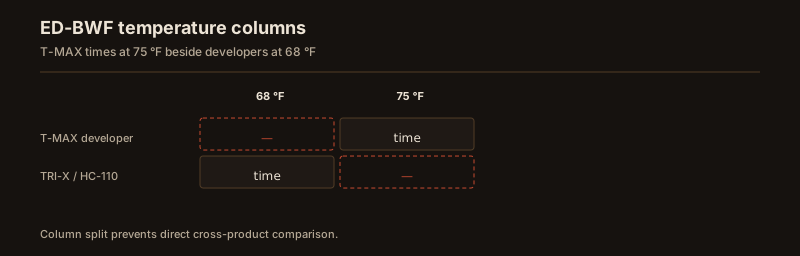
Kodak publication ED-BWF, Processing KODAK PROFESSIONAL Black-and-White Films, March 2023 (Revised 3-23), is a two-page summary that cites the film sheets F-4016, F-4043 and F-4017 as reference publications. Its development tables do not put every developer under one temperature. On both the roll small-tank table and the sheet tray table, the header splits: XTOL, D-76 and HC-110 (Dilution B) sit under 20°C (68°F); the T-MAX Developer (1:4) or T-MAX RS (1:4) column sits under 24°C (75°F).
That split is load-bearing. Read as a single 68°F row, the T-MAX cells disagree with the film sheets. Read under the printed headers, the T-MAX 100 and T-MAX 400 cells match. The TRI-X HC-110 cells do not match F-4017 either way. This article compares that layout and those matches and mismatches. It is not a development recipe.
The header is two temperatures
On page 1, under Roll Films: Small Tank Film Processing (Intermittent Agitation for Tanks That Can Be Inverted), ED-BWF’s development-time block is labelled:
| Header band | Developers under that band |
|---|---|
| 20°C (68°F) | XTOL; D-76; HC-110 (Dilution B) |
| 24°C (75°F) | T-MAX Developer (1:4) |
Page 2’s Sheet Films: Tray Processing table uses the same split, with T-MAX RS Developer and Replenisher (1:4) under 24°C (75°F).
ED-BWF opens by calling the figures starting-point recommendations and pointing readers to tests and to the named film publications. It does not warn, in prose, that the T-MAX column is a different temperature from the three columns to its left. The warning is the header itself.
T-MAX 100 and T-MAX 400 match when the header is obeyed
Against F-4016 June 2018 (T-MAX 100) and F-4043 February 2016 (T-MAX 400), the ED-BWF cells line up with the temperature each header assigns:
| Film / method | ED-BWF cell | Matching film-sheet cell |
|---|---|---|
| T-MAX 100 small tank, XTOL | 7½ min at 20°C | F-4016 small tank, XTOL at 68°F: 7½ |
| T-MAX 100 small tank, D-76 | 6½ min at 20°C | F-4016 small tank, D-76 at 68°F: 6½ |
| T-MAX 100 small tank, HC-110 (B) | 6 min at 20°C | F-4016 small tank, HC-110 (B) at 68°F: 6 |
| T-MAX 100 small tank, T-MAX (1:4) | 6¼ min at 24°C | F-4016 small tank, T-MAX (1:4) at 75°F: 6¼ — not the 7½ min F-4016 prints at 68°F |
| T-MAX 400 small tank, XTOL | 6½ min at 20°C | F-4043 small tank, XTOL at 68°F: 6½ |
| T-MAX 400 small tank, D-76 | 7½ min at 20°C | F-4043 small tank, D-76 at 68°F: 7½ |
| T-MAX 400 small tank, HC-110 (B) | 5½ min at 20°C | F-4043 small tank, HC-110 (B) at 68°F: 5½ |
| T-MAX 400 small tank, T-MAX (1:4) | 5½ min at 24°C | F-4043 small tank, T-MAX at 75°F: 5½ — not the 6¾ min F-4043 prints at 68°F |
The sheet-tray rows for those two films likewise match F-4016 and F-4043 when T-MAX RS is taken at 75°F and the other three developers at 68°F. For T-MAX 400, the matching tray block is the F-4043 tray table that includes an XTOL 1:1 row (XTOL 6, D-76 6¾, HC-110 5¼ at 68°F; T-MAX RS 4 at 75°F).
So the mixed header is not a conflict with the T-MAX film sheets. It is how ED-BWF compresses two temperature columns into one summary row. Treating the T-MAX figure as a 68°F time invents a disagreement the documents do not contain.
F-4016 already defines T-MAX “standard” at 75°F
F-4016’s contrast-adjustment section states that its development-time adjustment factors “are based on a developer temperature of 75°F (24°C) for KODAK PROFESSIONAL T-MAX Developers and a temperature of 68°F (20°C) for the others,” with “standard” marked by the factor 1.0. In that table, normal contrast is 1.0 at 75°F for the T-MAX developers and at 68°F for D-76 and HC-110 (Dilution B).
ED-BWF does not cite that paragraph. The same temperature pairing nevertheless appears in both places: T-MAX family times presented against a 75°F standard, the other named developers against 68°F. That is documentary alignment of convention, not proof that ED-BWF’s layout was derived from the F-4016 factor table.
TRI-X HC-110 does not match F-4017
ED-BWF’s TRI-X rows cite F-4017. F-4017 here is December 2016. Under the 20°C HC-110 column, ED-BWF does not reproduce F-4017’s 68°F HC-110 times.
| ED-BWF row | ED-BWF HC-110 at 20°C | F-4017 HC-110 (B) at 68°F | Same-sheet value that equals the ED-BWF cell |
|---|---|---|---|
| TRI-X 400, small tank | 6 min | 3¾ min | T-MAX small tank at 68°F: 6 min |
| TRI-X 320, tray | 6 min | 3¼ min | XTOL and D-76 tray at 68°F: 6 min each |
The other TRI-X cells in ED-BWF in ED-BWF do track F-4017 at the header temperatures: small-tank XTOL 7 and D-76 6¾ at 68°F, T-MAX 4¾ at 75°F; tray XTOL 6 and D-76 6 at 68°F, T-MAX RS NR at 75°F. The failure is local to the HC-110 column on both TRI-X lines.
No sheet in this set marks those ED-BWF HC-110 cells as errata, explains a different HC-110 dilution or agitation for the summary, or authorises substituting T-MAX or stock XTOL/D-76 times for HC-110. The usable statement is negative and scoped: for TRI-X HC-110, ED-BWF March 2023 is not a faithful extract of F-4017 December 2016 at 68°F.
What a citation has to carry
Anyone quoting a development time “from ED-BWF” has to carry the developer column and its header temperature, not only the film name and the minute figure. For T-MAX 100 and T-MAX 400, the summary matches the film sheets when that temperature is respected — and those matching cells are the PROFESSIONAL-named rows, not the legacy T-MAX 100 Professional rows; see J-86 keeps two T-MAX 100 time rows under different names. For TRI-X HC-110, the summary does not match the cited film sheet at 68°F, and the film sheet remains the tighter source for that cell. Speed vocabulary on the same film sheets is a parallel citation burden; see ISO and EI name different claims on published film sheets.
This page does not choose a working time, does not rank the publications, and does not treat any of these revisions as current beyond the dates printed on the files.
References
- Processing KODAK PROFESSIONAL Black-and-White Films, Kodak Alaris, publication ED-BWF, March 2023 (
Revised 3-23) — https://www.kodakprofessional.com/sites/default/files/wysiwyg/pro/resources/edbwf_0.pdf - KODAK PROFESSIONAL T-MAX 100 Film, Kodak Alaris, publication F-4016, June 2018 (
Revised 6-18) — https://www.kodakprofessional.com/sites/default/files/wysiwyg/pro/resources/f4016_TMax_100.pdf - KODAK PROFESSIONAL T-MAX 400 Film, Kodak Alaris, publication F-4043, February 2016 — https://www.kodakprofessional.com/sites/default/files/wysiwyg/pro/resources/f4043_TMax_400.pdf
- KODAK PROFESSIONAL TRI-X 320 and 400 Films, Kodak Alaris, publication F-4017, December 2016 — https://imaging.kodakalaris.com/sites/default/files/files/products/f4017_trix_320400.pdf
Share