Developer and fixer chemistry
“Stop bath or running water” is not one manufacturer rule
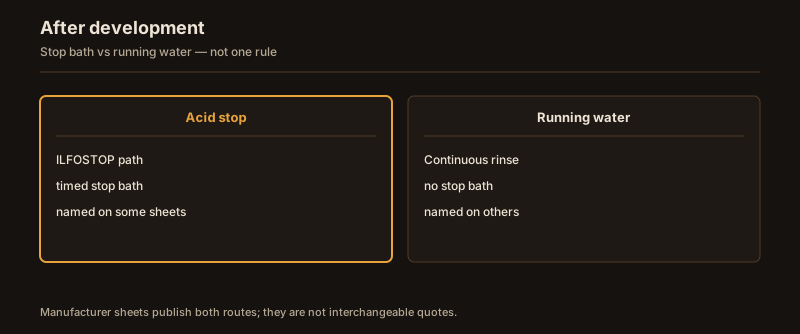
Separates four published stop-step framings the field collapses into one phrase: Kodak F-4016 for T-MAX 100 (June 2018) and F-4043 for T-MAX 400 (February 2016) equate Indicator Stop Bath with running water at 30 seconds; Kodak ED-BWF (March 2023) names only Indicator Stop Bath at 1:63 for the rinse/stop row; Kodak E-103CF (2010) tabulates Indicator Stop Bath at 1:63 for 30 seconds at 65–70°F with discard on purplish/blue and no water alternative; Kodak AJ-3 (February 2016) lists “stop bath or water” in film materials while its Stop Baths appendix says you need Indicator Stop Bath (1:63); and Ilford’s December 2017 Chemical Sundries sheet specifies ILFOSTOP at 1+19 for 10 seconds while framing a water bath as an occasional substitute that increases mark and stain risk.
Ask what comes after the developer and the answer often arrives as one phrase: stop bath or running water, about thirty seconds. That phrase is real on some Kodak film sheets. It is not the stop step those same manufacturers publish everywhere else, and it is not Ilford’s ILFOSTOP specification. The dated sheets below are the evidence — not a mixing, handling, reuse or disposal guide, and none is treated as current beyond the revisions named in the references.
Kodak film sheets equate the two paths
Kodak publication F-4016 for T-MAX 100, June 2018, under FINAL STEPS, states: rinse at 65 to 75°F (18 to 24°C) with agitation in Kodak Indicator Stop Bath or running water for 30 seconds. The February 2016 manufacturer revision of the same publication carries the same sentence. Sister film sheet F-4043 for T-MAX 400, February 2016, repeats the same Indicator Stop Bath / running water / 30-second line at the same temperature band.
On those film sheets, water is not framed as a degraded substitute. It is an equal alternative in the same sentence, for the same clock.
Other Kodak process sheets do not keep the equality
ED-BWF, March 2023, Processing KODAK PROFESSIONAL Black-and-White Films, gives a final-steps table whose rinse/stop row is 0:30 at 18 to 24°C (65 to 75°F) with continuous agitation, and whose comment is: rinse with a stop bath such as Kodak Professional Indicator Stop Bath (1:63). That row does not offer running water as a parallel option. Water appears later in the same table as a separate post-fix rinse and as wash water — different steps.
Developer sheets follow the stop-bath-only naming. J-109 for XTOL, February 2018, and J-86 for T-MAX Developers, December 2017, each give a final-steps line “Stop Bath 30 seconds” with continuous agitation. Neither reprints F-4016’s “or running water” fork.
AJ-3, How to Process and Print Black-and-White Film, February 2016, splits inside one booklet. The film-materials list says “Stop bath or water,” and the adjacent prose says you will need to use a stop bath (or water), such as Indicator Stop Bath, after the developer. The small-tank process table then labels the step only “Stop Bath 30 seconds.” The later Stop Baths appendix says that after development you will need a stop bath for rinsing film and prints, and names Kodak Indicator Stop Bath (1:63) as the liquid concentrate with a built-in exhaustion indicator. The “or water” permission is in the materials framing; the product appendix does not restate it.
E-103CF publishes the product row without a water column
Kodak publication E-103CF, Chemicals for KODAK PROFESSIONAL Black-and-White Films, Eastman Kodak Company 2010 (Wayback capture of the manufacturer PDF, 25 September 2012; PDF metadata modification 1 December 2010), is a chemistry summary rather than a film processing sheet. Its stop-bath table row for Indicator Stop Bath gives typical dilution 1:63, solution temperature/time 65 to 70°F (18 to 21°C) for 30 seconds, and the discard rule “discard when color changes to purplish/blue.” The descriptive block calls it a non-hardening general-purpose stop bath for films and papers that contains an indicator to signal exhaustion, and repeats “dilute 1 part concentrate with 63 parts water.”
That product row does not list running water as an alternate stop chemistry. It also narrows the temperature band relative to F-4016 / F-4043 / ED-BWF: 65–70°F on E-103CF versus 65–75°F on those process sheets. Same product name; different published temperature envelope depending on which Kodak document is open.
Ilford recommends acid stop and scopes water as a substitute
Ilford’s Chemical Sundries technical information sheet, updated December 2017, covers ILFOSTOP on the same document that also covers ILFOTOL and Washaid. ILFOSTOP is described as a low-odour citric acid stop bath. After development, the sheet recommends that films and papers be rinsed in an acid stop bath to stop development immediately and neutralise the developer to help maintain fixer activity. The published working figures are dilution 1+19, temperature range 18–24°C (64–75°F), and time for film and paper at 20°C (68°F) of 10 seconds. The indicator dye changes from yellow to purple as the bath becomes exhausted.
Water is not an equal alternative on that sheet. A later paragraph states that there are occasions when a stop bath cannot be included in the process sequence; in those circumstances a water bath or water rinse can be substituted. Using a water bath instead of a stop bath “increases the risk of seeing processing related marks and stains”; to reduce those risks the water bath must be completely changed at very frequent intervals; and if a water bath must be used, fewer fixing problems will be seen if fixer activity is monitored and adequate fixer replenishment rates are used.
So Ilford’s product sheet recommends acid stop, publishes a 10-second clock at 1+19, and treats water as an occasional substitute with stated process risks. That is a different claim structure from F-4016’s equal “or.”
| Kodak F-4016 June 2018 / F-4043 Feb 2016 | Kodak ED-BWF March 2023 | Kodak E-103CF 2010 | Kodak AJ-3 Feb 2016 | Ilford Chemical Sundries, Dec 2017 (ILFOSTOP) | |
|---|---|---|---|---|---|
| Stop chemistry named | Indicator Stop Bath or running water | Stop bath such as Indicator Stop Bath (1:63) | Indicator Stop Bath (1:63) | Materials: stop bath or water; appendix: Indicator Stop Bath (1:63) | Acid stop bath (ILFOSTOP); water only as substitute when stop cannot be included |
| Published time | 30 seconds | 0:30 | 30 seconds | Process table: 30 seconds | 10 seconds at 20°C (minimum; longer permitted with stain caveat) |
| Temperature band on that row | 65–75°F (18–24°C) | 18–24°C (65–75°F) | 65–70°F (18–21°C) | Process table uses the booklet’s film-process framing; appendix gives dilution not a separate temp band | 18–24°C (64–75°F) |
| Dilution published here | Not on the film-sheet rinse line | 1:63 | 1:63 | 1:63 in Stop Baths appendix | 1+19 |
| Exhaustion signal | Not on the rinse line | Not on the rinse row | Discard when color changes to purplish/blue | Built-in indicator; discard when exhausted | Indicator yellow → purple |
| Water framed as | Equal alternative | Not offered on the rinse/stop row | Not offered | Listed in materials / early prose; not restated in Stop Baths appendix | Occasional substitute with increased mark/stain risk |
Which sheet the stop step came from
None of these documents ranks citric ILFOSTOP against acetic Indicator Stop Bath, proves that a 10-second Ilford immersion equals a 30-second Kodak immersion, or measures how often F-4016’s water path produces the marks Ilford warns about. Capacity figures (Ilford’s unreplenished film and paper throughputs on the sundries sheet; E-103CF’s keeping-property columns) are product-specific and are not used here to rank brands. Silver limits, clearing-time rules and wash/permanence criteria are different kinds of claim and are handled elsewhere on this site — including “Twice the clearing time” names three published rules for the clearing-time fork that follows stop on the same Kodak final-steps tables, and ILFOSTOP PRO is specified on fixer sheets — Chemical Sundries does not document it for which Ilford document carries the machine stop product.
So a quoted stop step needs the sheet: whether water is an equal option (F-4016 / F-4043), omitted (ED-BWF rinse/stop row; E-103CF product row), mentioned only in materials framing (AJ-3), or scoped as a risk-bearing substitute (Ilford ILFOSTOP), and which clock and dilution that sheet actually publishes.
References
- KODAK PROFESSIONAL T-MAX 100 Film, Kodak Alaris, publication F-4016, June 2018 (
Revised 6-18) — https://www.kodakprofessional.com/sites/default/files/wysiwyg/pro/resources/f4016_TMax_100.pdf - KODAK PROFESSIONAL T-MAX 100 Film, Kodak Alaris, publication F-4016, February 2016 (
Revised 2-16) — https://business.kodakmoments.com/sites/default/files/files/products/f4016_TMax_100.pdf - KODAK PROFESSIONAL T-MAX 400 Film, Kodak Alaris, publication F-4043, February 2016 — https://www.kodakprofessional.com/sites/default/files/wysiwyg/pro/resources/f4043_TMax_400.pdf
- Processing KODAK PROFESSIONAL Black-and-White Films, Kodak Alaris, publication ED-BWF, March 2023 (
Revised 3-23) — https://www.kodakprofessional.com/sites/default/files/wysiwyg/pro/resources/edbwf_0.pdf - KODAK PROFESSIONAL XTOL Developer, Kodak Alaris, publication J-109, February 2018 — https://www.kodakprofessional.com/sites/default/files/wysiwyg/pro/chemistry/J-109_Feb_2018.pdf
- KODAK PROFESSIONAL T-MAX Developers, Kodak Alaris, publication J-86, December 2017 — https://www.kodakprofessional.com/sites/default/files/wysiwyg/pro/chemistry/j86.pdf
- How to Process and Print Black-and-White Film, Kodak Alaris, publication AJ-3, February 2016 (
Revised 2/16) — https://www.kodakprofessional.com/sites/default/files/wysiwyg/pro/resources/AJ-3.pdf - Chemicals for KODAK PROFESSIONAL Black-and-White Films, Eastman Kodak Company, publication E-103CF, © 2010; archived manufacturer PDF — https://web.archive.org/web/20120925030001id_/http://www.kodak.com/global/en/professional/support/techPubs/e103cf/e103cf.pdf; additional public mirror — https://125px.com/docs/techpubs/kodak/e103cf-2010_11.pdf
- ILFORD Sundry chemicals for processing black and white films and papers (Chemical sundries) technical information sheet, HARMAN technology Limited; PDF metadata modification date 2017-12-08; final-page line “Updated: Dec 2017”; archived Ilford manufacturer download — https://web.archive.org/web/20250516164800id_/https://www.ilfordphoto.com/amfile/file/download/file/1865/product/669/; additional public mirror — https://www.fomei.com/editor/image/eshop_products_files/5630/Pomocne_lazne_technical%20data%20sheet.pdf
Share