Developer and fixer chemistry
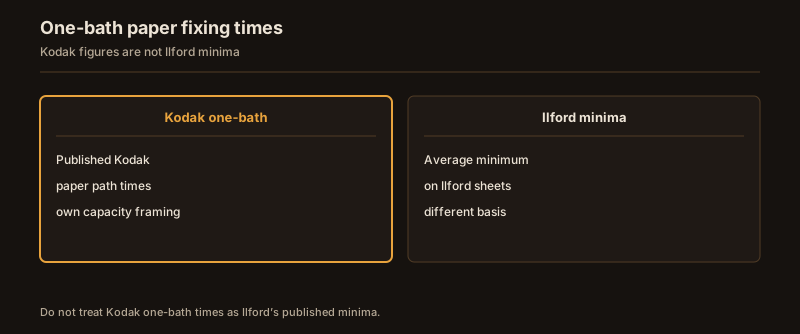
Kodak’s one-bath paper times are not Ilford’s average minima
Sets the Kodak Rapid Fixer pack-in (© Kodak 2015, code 20370811) tray fixing times at 18–24°C — 2 minutes (one-bath) / 1 minute per bath (two-bath) for resin-coated paper and 10 minutes (one-bath) / 2:30–5 minutes per bath (two-bath) for most non-resin-coated papers, with an explicit do-not-exceed note — beside Ilford Rapid Fixer (July 2010) and Hypam (August 2002) average minimum paper times at 20°C of ½ minute RC / 1 minute FB at 1+4 and 1 minute RC / 2 minutes FB at 1+9; records that Multigrade FB Classic (October 2013) restates the FB 1+4 path as 1:00; and records that AJ-3’s resin-coated tray procedure (February 2016) uses 2 minutes — matching Kodak’s RC one-bath figure, not Ilford’s half-minute RC row — while film bands on the same Kodak pack-in (2–4 / 3–5 minutes) overlap Ilford’s general-purpose film band (2–5 minutes at 1+4).
Kodak and Ilford both sell products called rapid fixer. On film, their time bands on these sheets overlap. On paper, the same product class publishes tray times that differ by a factor of about four on resin-coated stock and about ten on fibre-base / non-resin-coated stock when each maker’s one-bath path is read against the other. Dilution forks (Kodak film/paper charts; Ilford’s paper-only 1+9 clause) and capacity labels are separate kinds of claim already treated in AJ-3 names Rapid Fixer film 1:3 and paper 1:7 — E-103CF’s Rapid row does not and Ilford’s manual 1+9 is a paper clause, not a film path; the question here is which paper times each dated manufacturer sheet actually prints — not a mixing, handling, reuse or disposal guide.
Kodak’s pack-in prints absolute paper bands — and a ceiling
The Kodak Rapid Fixer pack-in instruction sheet (© Kodak 2015, code 20370811; one page) states paper fixing times for tray processing in a fresh fixing bath at 18 to 24°C (65 to 75°F), with frequent agitation:
| Paper class | Two-fixing-bath method (time in each bath) | One-fixing-bath method |
|---|---|---|
| Most non-resin-coated papers | 2:30 to 5 minutes | 10 minutes |
| Resin-coated, water-resistant papers | 1 minute | 2 minutes |
Immediately under that table the sheet says:
Do not fix prints longer than the times indicated above. The recommended fixing times provide complete fixing while minimizing absorption of hypo by the base of the paper.
So the one-bath non-resin-coated figure is not a loose starting point. On this pack-in it is both the recommended duration and a published ceiling. Those paper times sit on the same sheet as the separate papers preparation chart (Solution A and Solution B columns) whose Solution A volume is half the films-and-plates chart at the same final volume — the paper-bath arithmetic already documented elsewhere on this site. The pack-in does not reprint AJ-3’s “1:7” label beside the time table; it does attach the times to the paper path, not the films-and-plates path.
Ilford publishes average minima at named dilutions
Ilford Rapid Fixer, July 2010, introduces its fixing-times table as “average minimum fixing times at 20°C (68°F) for materials manually processed using fresh fixer.” The paper rows are:
| Material | Dilution | Time (minutes) |
|---|---|---|
| RC paper | 1+4 | ½ |
| RC paper | 1+9 | 1 |
| FB paper | 1+4 | 1 |
| FB paper | 1+9 | 2 |
Hypam, August 2002, carries the same paper rows in its without-hardener column (and marks hardener not applicable for paper). Multigrade FB Classic, October 2013, independently restates the fibre-base dish/tray path as Ilford Rapid Fixer or Hypam at 1+4 for 1:00 at 18–24°C (64–75°F). Multigrade also states that there is no benefit in extending fixation beyond the recommended time and that some loss of print quality might be seen when long fixing times are given, due to image etching. That caution is Ilford’s own recommended-time framing; it is not a cross-citation of Kodak’s ten-minute one-bath cell.
Ilford’s two-bath prose is a different claim structure from Kodak’s absolute per-bath bands. Rapid Fixer July 2010 describes two baths of equal volume and says to fix in the first bath for half the recommended fixing time and in the second for the remainder. For FB paper at 1+4, that arithmetic is thirty seconds plus thirty seconds against a one-minute recommended time. Kodak’s two-bath column for most non-resin-coated papers is two-and-a-half to five minutes in each bath. Sharing the phrase “two-bath” does not make the published clocks the same.
Side by side, the paper clocks are not one house rule
| Claim | Kodak Rapid Fixer pack-in, © 2015, 20370811 | Ilford Rapid Fixer, July 2010 / Hypam, Aug 2002 | Multigrade FB Classic, Oct 2013 | AJ-3, Feb 2016 |
|---|---|---|---|---|
| Document class | Pack-in instruction sheet | Fixer fact sheet | Fibre-base paper sheet | Process-and-print booklet |
| RC / resin-coated one-bath (or sole) tray time | 2 minutes at 18–24°C | ½ minute at 1+4; 1 minute at 1+9 (20°C average minimum) | Not an RC sheet | 2 minutes in the resin-coated tray procedure (“Do not overfix”) |
| FB / non-resin-coated one-bath tray time | 10 minutes at 18–24°C | 1 minute at 1+4; 2 minutes at 1+9 (20°C average minimum) | 1:00 at Rapid/Hypam 1+4, 18–24°C | No fibre-base fixing-time cell in that RC procedure |
| Kind of time claim | Absolute bands plus “do not fix … longer” | “Average minimum” table at named dilutions | Restates fixer-sheet FB 1+4 minute | Matches Kodak RC one-bath duration on RC path |
| Two-bath wording | Absolute minutes in each bath | Half recommended time, then remainder | Not tabulated as two-bath times | Not used in the RC tray steps |
Read as one conversational rule — “rapid fixer, a couple of minutes for RC, a bit longer for fibre” — these sources do not agree. Kodak’s RC one-bath cell is four times Ilford’s 1+4 RC minimum. Kodak’s non-resin-coated one-bath cell is ten times Ilford’s 1+4 FB minimum and five times Ilford’s weaker 1+9 FB row. AJ-3’s resin-coated procedure lands on Kodak’s two-minute RC figure, not on Ilford’s half-minute.
Film bands overlap; paper is where the sheets diverge
The same Kodak pack-in, for manual film processing at the same 18–24°C band, gives most Kodak professional films 2 to 4 minutes and T-MAX Professional Films 3 to 5 minutes. Ilford Rapid Fixer’s general-purpose film row at 1+4 is 2–5 minutes. Those film envelopes overlap. The cross-brand disagreement that survives on these sheets is the paper table, not the film band.
F-4016’s T-MAX film final-steps block (June 2018) restates Rapid Fixer at 3 to 5 minutes for film and does not publish a paper fixing-time table. It neither confirms nor retracts the pack-in’s paper bands. Paper times have to be read from the pack-in (and, for Ilford, from the fixer and Multigrade sheets), not inferred from a film publication.
Two paper clocks under one product name
None of these documents is used here to rank Kodak’s paper bath against Ilford’s 1+4 bath for clearing speed, residual thiosulfate, or print life, or to treat dilution difference as a complete arithmetic explanation of the gap — Ilford’s weaker FB 1+9 row is still only two minutes against Kodak’s ten-minute one-bath non-resin-coated cell. Capacity-per-gallon figures on the Kodak pack-in and capacity-per-litre figures on Ilford’s sheets are separate kinds of claim; see Capacity labels cannot rank rapid fixers. Later Kodak pack-in and Ilford Rapid Fixer revisions are outside this set.
On these sources, “how long to fix a print in rapid fixer” is 2 minutes RC / 10 minutes most non-RC on Kodak’s one-bath pack-in table (with a do-not-exceed note), and ½–1 minute RC / 1–2 minutes FB on Ilford’s average-minimum table at the dilutions those sheets name, with Multigrade confirming the FB 1+4 minute and AJ-3 confirming Kodak’s RC two minutes on a resin-coated path. Collapsing those into one rapid-fixer paper time erases the document split.
References
- KODAK RAPID FIXER instruction sheet (pack-in), Kodak Alaris; © Kodak 2015; code 20370811; one page — archived retailer-hosted copy https://web.archive.org/web/20250830090127id_/https://www.freestylephoto.com/static/pdf/product_pdf/kodak/KODAK_RAPID_FIXER_INSTRUCTIONS.pdf; original Freestyle URL https://www.freestylephoto.com/static/pdf/product_pdf/kodak/KODAK_RAPID_FIXER_INSTRUCTIONS.pdf
- ILFORD Rapid Fixer technical information sheet, HARMAN technology Limited; footer “Page 5 of 5 July 2010”; archived Ilford manufacturer download — https://web.archive.org/web/20260210013708id_/https://www.ilfordphoto.com/amfile/file/download/file/1833/product/711/; additional public mirror — https://assets.website-files.com/5ba2689b2e7121210bfa9af3/5c0ecc53472033a2b1b17efb_tech%20specs%20ilford%20rapid%20fixer.pdf
- ILFORD HYPAM FIXER & HARDENER fact sheet, August 2002 revision (footer
02033.www August 2002), 7 pages — https://web.archive.org/web/20030811061427id_/http://www.ilford.com/html/us_english/pdf/hypam.pdf, captured 11 August 2003; manufacturer endpoint https://www.ilfordphoto.com/amfile/file/download/file/1866/product/1728/ - ILFORD MULTIGRADE FB CLASSIC technical information sheet, HARMAN technology Limited; footer “Page n of 4 Oct 2013” on each page; archived Ilford manufacturer download — https://web.archive.org/web/20250828230624id_/https://www.ilfordphoto.com/amfile/file/download/file/1748/product/1735/; additional public mirror — https://www.macodirect.de/media/pdf/f0/3b/17/MG1K21_datenblatt_e%20.pdf
- How to Process and Print Black-and-White Film, Kodak Alaris, publication AJ-3, February 2016 (
Revised 2/16) — https://www.kodakprofessional.com/sites/default/files/wysiwyg/pro/resources/AJ-3.pdf - KODAK PROFESSIONAL T-MAX 100 Film, Kodak Alaris, publication F-4016, June 2018 (
Revised 6-18) — https://www.kodakprofessional.com/sites/default/files/wysiwyg/pro/resources/f4016_TMax_100.pdf
Share