Developer and fixer chemistry
AJ-3 names Rapid Fixer film 1:3 and paper 1:7 — E-103CF’s Rapid row does not
Sets Kodak AJ-3 (February 2016), which publishes “Dilute 1:3 for film and 1:7 for paper” for Rapid Fixer (and the same pair for KODAFIX), beside E-103CF (© 2010), which gives Rapid Fixer’s typical dilution only as “1:3 plus Part B (hardener)” with no paper fork in that cell or in the Rapid description block; records that E-103CF’s KODAFIX description carries the film/paper split the Rapid block lacks; and records that the Kodak Rapid Fixer pack-in (© Kodak 2015, code 20370811) separates film and paper preparation charts in which the paper chart lists half the Solution A — and half the Solution B — of the films-and-plates chart at the same final volume, the arithmetic of 1:7 versus 1:3 for Solution A, without printing AJ-3’s 1:7 label.
Kodak Rapid Fixer is routinely summarised as a single working dilution. On these Kodak sources that summary is not one claim. AJ-3 prints film 1:3 and paper 1:7 for the product. E-103CF’s Rapid Fixer typical-dilution cell prints only “1:3 plus Part B (hardener).” The pack-in that charts how the bath is prepared never writes “1:7,” but its paper chart uses half the Solution A of its film chart at the same final volume. The dated Kodak sheets below — with one Ilford Rapid Fixer sheet for cross-brand comparison — are the evidence, not a mixing, handling, reuse or disposal guide, and none is treated as current beyond the revisions named.
AJ-3 states the film/paper pair for Rapid Fixer
Kodak Alaris publication AJ-3, How to Process and Print Black-and-White Film, February 2016 (Revised 2/16), puts the split in two places.
In the print-making section, before naming a product, it says that the same type of stop bath and fixer used for film can be used for paper, “but be sure you mix it properly. Most fixers require a 1:3 dilution for use with film and a 1:7 dilution for paper. (See the fixer instructions.)”
In the later Fixing Baths chemicals summary, Rapid Fixer is not left under that “most fixers” gloss alone. The product entry reads:
An easy-to-use liquid concentrate for very rapid fixing of films and normal fixing of prints. It consists of two concentrates that you add to water to prepare the fixing bath. Dilute 1:3 for film and 1:7 for paper.
The same page gives KODAFIX Solution the identical dilution pair: “Dilute 1:3 for film and 1:7 for paper.” On AJ-3, then, Rapid Fixer and KODAFIX share a published film/paper dilution role.
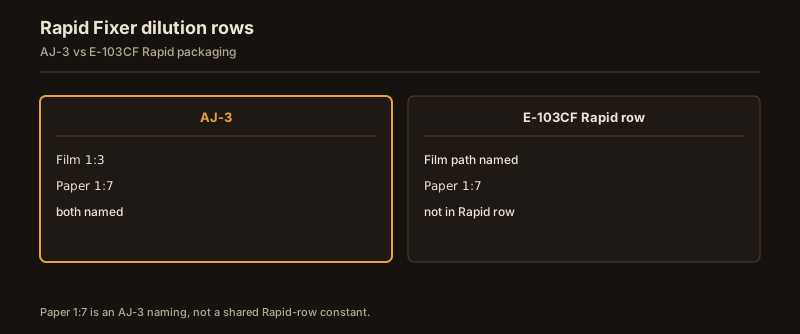
E-103CF’s Rapid row does not carry the paper fork
Kodak publication E-103CF, Chemicals for KODAK PROFESSIONAL Black-and-White Films, Eastman Kodak Company © 2010 (manufacturer PDF via Wayback capture 25 September 2012), is a different document class: a chemistry summary with a typical-dilution table.
Its Rapid Fixer row gives typical dilution as:
1:3 plus Part B (hardener)
The descriptive block on the same sheet says Rapid Fixer is a fast-acting hardening fixer consisting of Solution A (the fixer concentrate) and Solution B (the hardener concentrate), “for use with film and paper.” It does not restate a paper dilution. The table cell that is supposed to hold the typical dilution never shows 1:7.
KODAFIX on the same sheet is the contrast that makes the omission sharp. The KODAFIX typical-dilution cell prints only “1:3,” but the KODAFIX descriptive block supplies the missing paper fork:
Dilute 1 part concentrate to 3 parts water for use with film; 1 part concentrate to 7 parts water for use with paper
So E-103CF knows how to publish a film/paper dilution pair in prose. It does so for KODAFIX. It does not do so for Rapid Fixer. A reader who has only E-103CF’s Rapid row has “1:3 plus Part B (hardener)” and a film-and-paper product claim, not AJ-3’s “1:3 for film and 1:7 for paper.”
| AJ-3, Feb 2016 | E-103CF, © 2010 | Rapid Fixer pack-in, © Kodak 2015, code 20370811 | |
|---|---|---|---|
| Rapid Fixer film dilution wording | “Dilute 1:3 for film …” | Typical dilution “1:3 plus Part B (hardener)” | Films-and-plates preparation chart (Solution A and Solution B columns) |
| Rapid Fixer paper dilution wording | “… and 1:7 for paper” | No paper dilution in Rapid table cell or Rapid description | Separate papers preparation chart; no “1:7” label on that sheet |
| KODAFIX film/paper pair on same document | Same “1:3 for film and 1:7 for paper” | Description: 1 part to 3 parts water for film; 1 part to 7 parts water for paper (table cell shows only “1:3”) | Not a KODAFIX sheet |
| Document class | Process-and-print booklet with chemicals appendix | Chemicals summary / typical-dilution table | Pack-in preparation charts |
Whether Solution B is labeled a hardener is handled in Kodak names Rapid Fixer Solution B a hardener on E-103CF — not on the pack-in. What matters here is the dilution fork itself: AJ-3 names paper 1:7 for Rapid Fixer; E-103CF’s Rapid row does not.
The pack-in charts the half-strength paper bath without the 1:7 label
The Kodak Rapid Fixer pack-in instruction sheet (© Kodak 2015, code 20370811; one page) is the sheet that publishes preparation charts. It has one chart for films and plates and another for papers. Both include Solution A and Solution B. A full-page OCR of that file finds no occurrence of the string 1:7.
What the charts do publish, for the same final volume of 3.8 L / 1 gallon, is a paper path whose Solution A volume is half the films-and-plates Solution A volume, and whose Solution B volume is likewise half. At that final volume the films-and-plates Solution A figure is 946 mL; the papers figure is 473 mL. That is the arithmetic of one part in four of final volume versus one part in eight — Kodak’s usual 1:3 versus 1:7 concentrate-to-water framing for Solution A — without AJ-3’s labels appearing on the pack-in.
The pack-in therefore agrees with AJ-3’s film/paper split as chart arithmetic while disagreeing with E-103CF’s Rapid presentation as labeling. E-103CF collapses Rapid into one typical-dilution cell. The pack-in separates two preparation charts. AJ-3 names both dilutions in words.
F-4016 for T-MAX 100, June 2018, under FINAL STEPS, names Kodak Rapid Fixer with a 3 to 5 minute film band and does not publish either dilution. It neither restores AJ-3’s 1:7 paper claim nor reprints E-103CF’s “1:3 plus Part B” cell. A film sheet that only points at the product name does not settle which dilution document applies when the reader later mixes for paper.
Ilford’s Rapid path is a different kind of claim
Ilford Rapid Fixer, July 2010, does not use Kodak’s 1:3 / 1:7 pair. Film is diluted 1+4. The optional weaker bath, 1+9, sits in the paper-machine / manual-paper paragraph and is tabulated for paper only — a paragraph boundary treated in Ilford’s manual 1+9 is a paper clause, not a film path. That Ilford structure is useful here only as cross-brand comparison: sharing the commercial phrase “rapid fixer” does not make Kodak’s AJ-3 film/paper pair, E-103CF’s single Rapid cell, or Ilford’s 1+4 / 1+9 paper clause the same published dilution system. Paper fixing times on the pack-in path are a separate fork; see Kodak’s one-bath paper times are not Ilford’s average minima.
Three dilution presentations, one product name
None of these documents is used here to rank film 1:3 against paper 1:7 for speed, capacity or permanence, to identify the chemical composition of Solution B, or to treat AJ-3’s shorthand “Dilute 1:3” as a complete substitute for the pack-in’s two-concentrate chart. Capacity figures, hardener labeling, and Ilford’s paper-only 1+9 path are separate kinds of claim. Later Kodak chemicals catalogues and pack-in revisions are outside this set.
On these sources, “Kodak Rapid Fixer dilution” is film 1:3 and paper 1:7 where AJ-3 says so; “1:3 plus Part B (hardener)” where E-103CF’s Rapid row says so; and two unlabeled preparation charts on the pack-in whose Solution A volumes stand in the 1:3 / 1:7 ratio without printing the 1:7 words. Collapsing those presentations into one house dilution erases the document split.
References
- How to Process and Print Black-and-White Film, Kodak Alaris, publication AJ-3, February 2016 (
Revised 2/16) — https://www.kodakprofessional.com/sites/default/files/wysiwyg/pro/resources/AJ-3.pdf - Chemicals for KODAK PROFESSIONAL Black-and-White Films, Eastman Kodak Company, publication E-103CF, © 2010; archived manufacturer PDF — https://web.archive.org/web/20120925030001id_/http://www.kodak.com/global/en/professional/support/techPubs/e103cf/e103cf.pdf; additional public mirror — https://125px.com/docs/techpubs/kodak/e103cf-2010_11.pdf
- KODAK RAPID FIXER instruction sheet (pack-in), Kodak Alaris; © Kodak 2015; code 20370811; one page — archived retailer-hosted copy https://web.archive.org/web/20250830090127id_/https://www.freestylephoto.com/static/pdf/product_pdf/kodak/KODAK_RAPID_FIXER_INSTRUCTIONS.pdf; original Freestyle URL https://www.freestylephoto.com/static/pdf/product_pdf/kodak/KODAK_RAPID_FIXER_INSTRUCTIONS.pdf
- KODAK PROFESSIONAL T-MAX 100 Film, Kodak Alaris, publication F-4016, June 2018 (
Revised 6-18) — https://www.kodakprofessional.com/sites/default/files/wysiwyg/pro/resources/f4016_TMax_100.pdf - ILFORD Rapid Fixer technical information sheet, HARMAN technology Limited; footer “Page 5 of 5 July 2010”; archived Ilford manufacturer download — https://web.archive.org/web/20260210013708id_/https://www.ilfordphoto.com/amfile/file/download/file/1833/product/711/; additional public mirror — https://assets.website-files.com/5ba2689b2e7121210bfa9af3/5c0ecc53472033a2b1b17efb_tech%20specs%20ilford%20rapid%20fixer.pdf
Share