
Archival permanence
Status A blue density is not one permanence ceiling
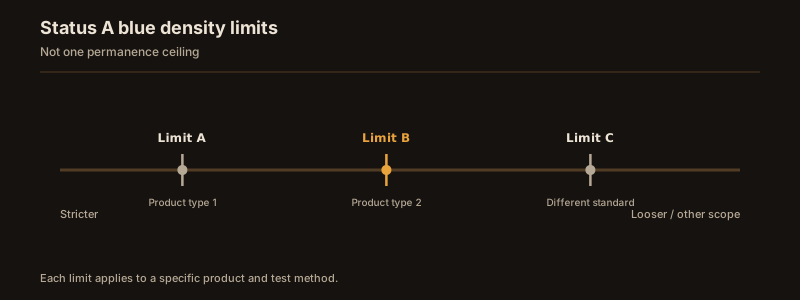
Separates three ISO permanence clauses that all use Status A blue densitometry yet publish three different numeric ceilings for three different tests: ISO 18901:2010 Clause 6.5 caps residual silver compounds on film at a 0,02 Status A blue density increase; Clause 7.2 caps radiographic-film image-stability change after incubation at 0,05 Status A blue density units for LE-10, LE-100 and LE-500 alike; and ISO 18929:2012 Clause 6.3 caps print yellowing after incubation at 0,08 Status A blue density units on minimum-density areas — so a quoted Status A blue permanence number has to name which clause and material it came from.
“Status A blue density” sounds like one densitometric permanence yardstick. On the film and print standards it is not. Three different clauses attach three different numeric ceilings to that same densitometric vocabulary, for three different tests, on two material classes. The comparison below is of those Status A blue density ceilings — not a densitometry procedure, a wash or fix recipe, or a measurement of any particular negative or print.
Film residual silver: 0,02
ISO 18901:2010, Imaging materials — Processed silver-gelatin-type black-and-white films — Specifications for stability, second edition, 2010-05-01, puts residual silver under Clause 6.5, titled Residual silver compounds:
Processed film shall not show more than an increase of 0,02 in Status A blue density when tested in accordance with 8.9 (see Annex C).
The free preview states the limit and names the test clause. It does not reproduce the unpaid Clause 8.9 procedure body. What the requirement itself carries is enough for this matrix: residual silver on film is judged by a Status A blue densitometric increase of at most 0,02.
That residual-silver densitometric cap sits next to, and apart from, Table 2’s residual-thiosulfate ceilings. Residual silver is a density limit on film and a mass limit on prints already separates the film density limit from the print atomic-absorption mass limit. The point here is only that 0,02 is one Status A blue number among others on these permanence texts — not the densitometric permanence number.
Radiographic image stability after incubation: 0,05 for every LE tier
The same film standard then opens a separate image-stability chapter. Clause 7.1 says the specifications and test methods for image stability “vary for different product types,” requires Status A blue (or visual diffuse) density measurement on a densitometer conforming to ISO 5-2 and ISO 5-3 geometry and spectral conditions, and points specimens to incubation as described in 8.10.3.
Clause 7.2, for radiographic films, is the first product-type rule the free preview still carries in full:
An area of unexposed processed film shall be tested. The Status A blue density change of the unexposed area shall be no greater than 0,05 density units after incubation. This requirement shall apply to LE-10, LE-100 and LE-500 films.
So on radiographic film, that image-stability densitometric ceiling is 0,05 Status A blue density units after incubation, and it is the same figure for all three LE ratings named in that clause.
That flatness matters because residual thiosulfate on the same standard is not flat across those ratings. Table 2 allows radiographic film up to 0,100 g/m² residual thiosulfate at LE-10, 0,050 g/m² at LE-100, and 0,020 g/m² at LE-500. The LE ladder on that film class tightens the thiosulfate ceiling; Clause 7.2’s image-stability ceiling does not. Quoting “the LE-100 densitometric limit” for radiographic film without naming the clause therefore collapses two different kinds of claim: a tiered residual-thiosulfate row and an untiered post-incubation Status A blue change.
The ISO 18901 free preview truncates during Clause 7.2. Microfilm and “other films” image-stability subclauses are listed in the table of contents but are not available as load-bearing text here, so this article does not invent their numbers.
Print yellowing after incubation: 0,08
ISO 18929:2012, Imaging materials — Wet-processed silver-gelatin type black-and-white photographic reflection prints — Specifications for dark storage, second edition, 2012-04-01, puts a third Status A blue ceiling under Clause 6.3, titled Yellowing limit:
The status A blue density of minimum density areas shall not increase by more than 0,08 units on the front (emulsion) surface or the back surface of the prints after incubation under conditions specified in 8.3.2 and testing as described in 8.3.3.
That 0,08 figure is a yellowing limit after incubation, applied to minimum-density areas on reflection prints. It is not the film residual-silver 0,02 test, and it is not the radiographic image-stability 0,05 test. Clause 7 then awards LE rating 100 to prints that meet all the specifications in the standard — residual thiosulfate, residual silver concentration, this yellowing limit, and the Clause 5 physical-stability requirements together. Yellowing is therefore part of the print LE-100 package, but the densitometric number attached to it is 0,08, not 0,02 or 0,05.
Print residual silver on the same standard is a mass concentration (0,025 g/m² by atomic absorption), not a Status A blue density change. The print Status A blue number in that image-stability block is the yellowing clause.
Three Status A blue ceilings, three tests
| Source and Status A blue role | What the number is for | Ceiling as written |
|---|---|---|
| ISO 18901:2010 §6.5 | Residual silver compounds on film | ≤ 0,02 density increase; test per 8.9 / Annex C |
| ISO 18901:2010 §7.2 | Radiographic-film image stability after incubation | ≤ 0,05 density units; applies to LE-10, LE-100 and LE-500 |
| ISO 18929:2012 §6.3 | Print yellowing after incubation (Dmin, front or back) | ≤ 0,08 density units; test per 8.3.2 / 8.3.3 |
These previews do not convert any of these ceilings into each other, and they do not state that a film residual-silver reading and a print yellowing reading are the same measurement because both say “Status A blue.” Clause 8 procedure bodies beyond what the free previews reproduce are not used as load-bearing evidence here.
Saying a material was checked by Status A blue densitometry does not, on these texts, say which permanence clause was applied, which numeric ceiling governed the result, or — for radiographic film — whether an LE tier changed that densitometric number at all.
References
- ISO 18901:2010, Imaging materials — Processed silver-gelatin-type black-and-white films — Specifications for stability, second edition, 2010-05-01; Clause 6.5 (residual silver compounds; Status A blue density increase of 0,02), Clause 7.1–7.2 (image-stability densitometry; radiographic Status A blue density change ≤ 0,05 after incubation for LE-10, LE-100 and LE-500), and Table 2 radiographic residual-thiosulfate rows — catalogue entry https://www.iso.org/standard/51029.html; free preview reproducing those clauses at https://cdn.standards.iteh.ai/samples/51029/98eeb0c2dc1944c8ad8ac647494eea22/ISO-18901-2010.pdf
- ISO 18929:2012, Imaging materials — Wet-processed silver-gelatin type black-and-white photographic reflection prints — Specifications for dark storage, second edition, 2012-04-01; Clause 6.3 (yellowing limit; Status A blue density increase ≤ 0,08 on minimum-density areas after incubation), Clause 7 (LE rating 100 for prints meeting all specifications), and Clause 6.2 context for residual silver as a separate, non-densitometric print requirement — catalogue entry https://www.iso.org/standard/55696.html; free preview at https://preview.sist.si/sist-preview/55696/9fabc925198b4de5ad1999feb80d8d44/ISO-18929-2012.pdf
Share