
Process control
Kodak’s PHOTO-FLO step is 30 seconds or 30 seconds to 1 minute
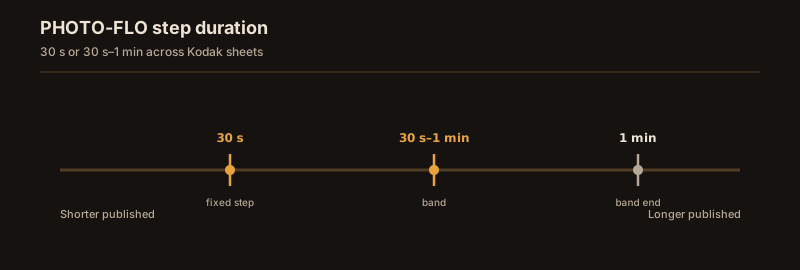
Records that Kodak XTOL J-109 publishes a PHOTO-FLO Solution time of 30 seconds to 1 minute in its final-steps table, while AJ-3, J-86, ED-BWF and TRI-X F-4017 publish a fixed 30-second wetting or final-rinse step, and T-MAX F-4016 / F-4043 name PHOTO-FLO after washing without printing a time.
Kodak does not publish one PHOTO-FLO / wetting-agent duration across its film and process sheets.
On XTOL developer sheet J-109, the final-steps table gives PHOTO-FLO Solution a band of 30 seconds to 1 minute. On AJ-3, T-MAX Developers J-86, the ED-BWF summary, and TRI-X film sheet F-4017, the matching wetting or final-rinse step is a fixed 30 seconds. On T-MAX film sheets F-4016 and F-4043, PHOTO-FLO is named after washing with no time figure at all. Those published times are what this page compares — not a wetting-agent recipe, and not a choice of which duration a worker should use.
J-109’s band: 30 seconds to 1 minute
KODAK PROFESSIONAL XTOL Developer, Kodak Alaris publication J-109, February 2018, under Final Steps in Small-Tank, Tray, and Rotary-Tube Processing, prints:
| Step | Time | Comments |
|---|---|---|
| PHOTO-FLO Solution | 30 seconds to 1 minute | To minimize drying marks, treat the film with KODAK PHOTO-FLO Solution after washing. |
In that PDF, the step label and the “30 seconds to 1 minute” time sit on the same row. That note does not reprint the five-second gentle-agitation sentence that appears on the 30-second wetting rows of AJ-3, J-86 and ED-BWF.
The same band is already on the March 2008 Kodak Moments-hosted J-109 and on the April 1998 third-party J-109 mirror (New 4-98). Across those three revisions the PHOTO-FLO time cell is the band, not a single 30-second figure.
Fixed 30 seconds on AJ-3, J-86, ED-BWF and F-4017
AJ-3, How to Process and Print Black-and-White Film, February 2016 (Revised 2/16), steps the process through a numbered table. Step 7 is:
| Step | Time | Agitation and Notes |
|---|---|---|
| 7. Wetting Agent | 30 seconds | Provide gentle agitation for 5 seconds of the total time. To reduce drying scum, mix KODAK PHOTO-FLO Solution with distilled water in areas that have hard water. |
The same sheet’s Other Chemicals appendix separately names KODAK PHOTO-FLO 200 Solution and states “Dilute 1 part concentrate to 200 parts water for use.” That appendix is a product dilution note; it does not replace the process-table time cell, and it is not what creates the conflict with J-109. The conflict is the time figure itself.
J-86 for KODAK PROFESSIONAL T-MAX Developers, December 2017 (Revised 12-17), page-12 Quick Reference to Processing Films, keeps the same fixed clock on step 7:
| Step | Time | Agitation and Notes |
|---|---|---|
| 7. Wetting Agent | 30 seconds | Provide gentle agitation for 5 seconds of the total time. To reduce drying scum, mix KODAK PHOTO-FLO Solution with distilled water in areas that have hard water. |
ED-BWF, Processing KODAK PROFESSIONAL Black-and-White Films, March 2023 (Revised 3-23), labels the step Final rinse/wetting agent and prints 0:30, with PHOTO-FLO after washing and the same five-second gentle-agitation sentence.
TRI-X film sheet F-4017, December 2016, under FINAL STEPS, puts the product name and the fixed time on one Final Rinse row:
| Step | Time |
|---|---|
| Final Rinse: KODAK PHOTO-FLO Solution | 0:30 |
So four non-XTOL sheets that do print a wetting/final-rinse duration agree on thirty seconds. None of them prints J-109’s upper bound of one minute. J-86’s Quick Reference also crosses rinse and Hypo Clearing Agent notes on the same page-12 table; see J-86’s quick reference swaps the rinse and Hypo Clearing Agent notes.
T-MAX film sheets name PHOTO-FLO without a time
F-4016 for KODAK PROFESSIONAL T-MAX 100 Film / 100TMX, June 2018 (Revised 6-18), under FINAL STEPS, after the wash paragraph, states:
Dry film in a dust-free place. To minimize drying marks, treat the film with KODAK PHOTO-FLO Solution after washing, or wipe the surface carefully with a KODAK Photo Chamois or a soft viscose sponge.
Sister sheet F-4043 for T-MAX 400, February 2016, repeats the same PHOTO-FLO sentence with a photo chamois / soft viscose sponge alternative. Neither FINAL STEPS block prints 0:30, 30 seconds, or 30 seconds to 1 minute beside PHOTO-FLO. Searching those PDFs turns up no wetting-agent time figure attached to that product name.
Those sheets therefore do not adjudicate between J-109’s band and the fixed 30-second cells. They omit the clock. The wash step that precedes PHOTO-FLO on those same final-steps tables carries three published framings; see Kodak’s film wash is 20–30 or 5 by sheet.
Three published clocks, not one rule
A quote of Kodak’s PHOTO-FLO or wetting-agent step time from this set is either:
- J-109’s 30 seconds to 1 minute PHOTO-FLO Solution cell (stable in the 1998, 2008 and 2018 revisions),
- the fixed 30-second wetting / final-rinse cells on AJ-3, J-86, ED-BWF and F-4017, or
- F-4016 / F-4043’s PHOTO-FLO wording without a published time,
unless the citation names the document and the row.
None of these sheets marks J-109’s band as superseded, states that the fixed 30-second cells govern when the sheets disagree, or supplies a cross-reference that collapses the three framings into one instruction. Treating “Kodak says 30 seconds in Photo-Flo” as a single manufacturer rule, or reading a minute out of F-4016 / F-4043, goes past the documents.
References
- KODAK PROFESSIONAL XTOL Developer, Kodak Alaris, publication J-109, February 2018 — https://www.kodakprofessional.com/sites/default/files/wysiwyg/pro/chemistry/J-109_Feb_2018.pdf
- KODAK PROFESSIONAL XTOL Developer, Eastman Kodak Company, publication J-109, March 2008 — https://business.kodakmoments.com/sites/default/files/files/resources/j109.pdf
- KODAK XTOL Developer, Eastman Kodak Company, publication J-109, April 1998 (
New 4-98); third-party mirror, not manufacturer-hosted — https://125px.com/docs/techpubs/kodak/j109-1998_04.pdf - How to Process and Print Black-and-White Film, Kodak Alaris, publication AJ-3, February 2016 (
Revised 2/16) — https://www.kodakprofessional.com/sites/default/files/wysiwyg/pro/resources/AJ-3.pdf - KODAK PROFESSIONAL T-MAX Developers, Kodak Alaris, publication J-86, December 2017 (
Revised 12-17) — https://business.kodakmoments.com/sites/default/files/files/resources/j86.pdf - Processing KODAK PROFESSIONAL Black-and-White Films, Kodak Alaris, publication ED-BWF, March 2023 (
Revised 3-23) — https://www.kodakprofessional.com/sites/default/files/wysiwyg/pro/resources/edbwf_0.pdf - KODAK PROFESSIONAL TRI-X 320 and 400 Films, Kodak Alaris, publication F-4017, December 2016 — https://imaging.kodakalaris.com/sites/default/files/files/products/f4017_trix_320400.pdf
- KODAK PROFESSIONAL T-MAX 100 Film, Kodak Alaris, publication F-4016, June 2018 (
Revised 6-18) — https://www.kodakprofessional.com/sites/default/files/wysiwyg/pro/resources/f4016_TMax_100.pdf - KODAK PROFESSIONAL T-MAX 400 Film, Kodak Alaris, publication F-4043, February 2016 — https://www.kodakprofessional.com/sites/default/files/wysiwyg/pro/resources/f4043_TMax_400.pdf
Share