Archival permanence
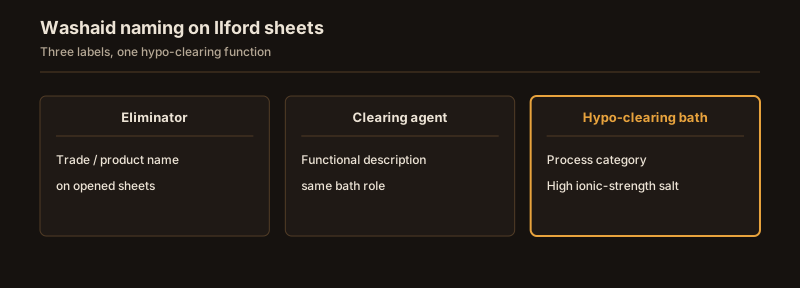
Ilford Washaid is labeled eliminator and clearing agent
Records that Ilford’s December 2017 Chemical Sundries sheet introduces Washaid as a hypo-clearing agent and then describes the same product as a hypo-eliminator that removes thiosulfate by ion exchange — the mechanism ISO 18901 and ISO 18929 assign to permitted hypo-clearing baths, not to the oxidizing hypo-eliminating agents those standards prohibit — and that Kodak AJ-3 keeps the clearing-agent name while excluding RC papers for a short-wash reason that is not the permanence-section wording ISO 18929 uses for the same exclusion.
ISO 18901 and ISO 18929 put two differently named baths on opposite sides of a permanence rule. Hypo-eliminating agents that work by oxidation “shall not be used.” Hypo-clearing baths — high-ionic-strength salt solutions that speed washing without chemically changing thiosulfate — are the permitted class. That taxonomy, and the residual-band floor that sits beside it, is developed in Washing to zero is not what the standards ask for. Ilford’s own December 2017 Chemical Sundries sheet puts both names on one product, Washaid, and describes a mechanism that matches only one of those classes.
The useful fact is documentary, not a wash sequence: the manufacturer vocabulary and the standards vocabulary do not line up, and a second manufacturer’s RC exclusion uses a different reason from the print standard.
One Ilford sheet uses both names
HARMAN technology’s Sundry chemicals for processing black and white films and papers fact sheet, footer-updated December 2017, opens by saying the sundries range includes “a stop bath, wetting agent and a hypo-clearing agent.” The three products treated in the sheet are Ilfostop, Ilfotol and Washaid. The introductory sentence therefore classifies Washaid, the washing-aid product, as a hypo-clearing agent.
Two pages later, under the Washaid heading, the same sheet states:
ILFORD WASHAID is a hypo-eliminator formulated to aid the efficient removal of the thiosulphate by-products of fixation by ion exchange.
So the sheet that a reader would open for Washaid calls it a clearing agent in the product-family introduction and an eliminator in the product description. Neither sentence says the other is wrong, superseded, or scoped to a different formulation. The revision line is a single “Updated: Dec 2017” on the final page; there is no changelog that reconciles the two labels.
The stated mechanism matches the ISO clearing class
The Washaid description does not stop at the word “hypo-eliminator.” It supplies a mechanism: removal of fixation thiosulfate by-products “by ion exchange,” and it scopes the product to “all ILFORD films and fibre papers.” RC paper is not named in the Washaid section at all.
ISO 18901’s processing clause draws the taxonomy the darkroom word “eliminator” usually collapses:
Hypo-eliminating agents containing oxidizing agents such as peroxides or hypochlorites shall not be used.
A note immediately distinguishes that banned class from hypo-clearing baths, “which are high ionic strength salt solutions” that “facilitate the washing of thiosulfate from the film, but do not chemically alter the thiosulfate.”
ISO 18929 repeats the same split for prints, prohibits oxidizing hypo-eliminating agents because they attack the silver image, and then describes hypo-clearing solutions — “such as a 2 % solution of sodium sulfite containing a wetting agent” — as facilitating washing of thiosulfate from fibre prints “without chemically altering the thiosulfate.”
Ilford’s ion-exchange wording sits with the clearing side of that split: a bath that helps thiosulfate leave the material, not an oxidizer that decomposes it. The sheet never claims peroxide or hypochlorite action. Calling the same product a “hypo-eliminator” therefore uses the standards’ banned-class name for a mechanism the standards attach to the permitted class. The page-1 “hypo-clearing agent” label matches the mechanism text; the page-3 “hypo-eliminator” label does not.
Nothing on that Ilford sheet, or in the ISO previews, is a composition assay of Washaid. The reconciliation is of published names and stated mechanisms, not of an independent chemical analysis.
Kodak keeps one name and a different RC reason
Kodak Alaris publication AJ-3, How to Process and Print Black-and-White Film, February 2016 / Revised 2/16, never calls its counterpart an eliminator. The product is “KODAK PROFESSIONAL Hypo Clearing Agent” throughout. The chemicals summary says it “shortens washing times and makes possible more thorough washing of films and prints,” reduces wash time to five minutes for films and ten or twenty minutes for single- or double-weight papers, and then:
This water-saving chemical is not recommended for water-resistant, resin-coated (RC) papers, which already have a short wash time (4 minutes).
ISO 18929 also keeps hypo-clearing off RC prints — “They should not be used for RC prints” — but that sentence follows the fibre-print washing-aid description in the processing requirements, not a claim that RC already washes quickly enough. Kodak’s stated reason is wash duration. The print standard’s wording is a use restriction in the permanence specification. Both exclude RC; they do not publish the same rationale.
Ilford’s Washaid section never recommends RC use either, but it does so by omission: film and fibre papers are named, RC is not. That is narrower than Kodak’s explicit “not recommended” and narrower than ISO 18929’s “should not,” and it is not a third independent explanation.
Two names, one ion-exchange mechanism
The Ilford sheet does not say why it uses “eliminator” for ion-exchange chemistry. ISO does not adjudicate manufacturer product names. Kodak AJ-3 does not cite ISO 18929, and ISO 18929 does not name Kodak Hypo Clearing Agent or Ilford Washaid.
What these documents do support is narrower. For Washaid, one manufacturer sheet carries both of the standards’ class names and a mechanism that matches only the clearing class. For RC paper, Kodak’s clearing-agent sheet and the print permanence standard agree on exclusion while disagreeing on the published reason. A reader who treats “hypo eliminator” and “hypo clearing agent” as synonyms, or who treats “not for RC” as a single explained rule, is reading past disagreements the primary documents leave standing. The same sundries sheet also publishes conflicting final-wash minutes for the fibre-base Washaid path; see Washaid’s final wash is five minutes and twenty on one page.
References
- ILFORD Sundry chemicals for processing black and white films and papers (Chemical sundries) technical information sheet, HARMAN technology Limited; PDF metadata modification date 2017-12-08; final-page line “Updated: Dec 2017”; archived Ilford manufacturer download — https://web.archive.org/web/20250516164800id_/https://www.ilfordphoto.com/amfile/file/download/file/1865/product/669/; additional public mirror — https://www.fomei.com/editor/image/eshop_products_files/5630/Pomocne_lazne_technical%20data%20sheet.pdf
- KODAK PROFESSIONAL publication AJ-3, How to Process and Print Black-and-White Film, Kodak Alaris Inc., February 2016 / “Revised 2/16” — https://www.kodakprofessional.com/sites/default/files/wysiwyg/pro/resources/AJ-3.pdf
- ISO 18901:2010, Imaging materials — Processed silver-gelatin-type black-and-white films — Specifications for stability; Clause 6.4 including Note 1 on hypo-eliminating agents and hypo-clearing baths — free preview at https://cdn.standards.iteh.ai/samples/51029/98eeb0c2dc1944c8ad8ac647494eea22/ISO-18901-2010.pdf
- ISO 18929:2012, Imaging materials — Wet-processed silver-gelatin type black-and-white photographic reflection prints — Specifications for dark storage; Clause 6.1 wording on hypo-eliminating agents and hypo-clearing solutions, including the RC exclusion — free preview at https://preview.sist.si/sist-preview/55696/9fabc925198b4de5ad1999feb80d8d44/ISO-18929-2012.pdf
Share